When you purchase through links on our site, we may earn a commission at no extra cost to you. Learn more.
Cats have plenty of ways to make us feel chosen. They curl up against us at night, weave around our legs, knead our laps, follow us into the bathroom, and occasionally stare into our eyes like we’re the most fascinating creature they’ve ever encountered.
Table of Contents
Naturally, we translate all of this as “My cat loves me.” And often, we’re right.
But cats are complicated little creatures, and some of their sweetest behaviors can mean more than one thing. That cuddle session, slow blink, or sudden need to supervise your every move may have another explanation hiding underneath it.
So, what is your cat really telling you?
Want our human-written content to rank above AI-generated garbage? Help us out by clicking this button!
The Trick To Reading Your Cat’s “Love Language”
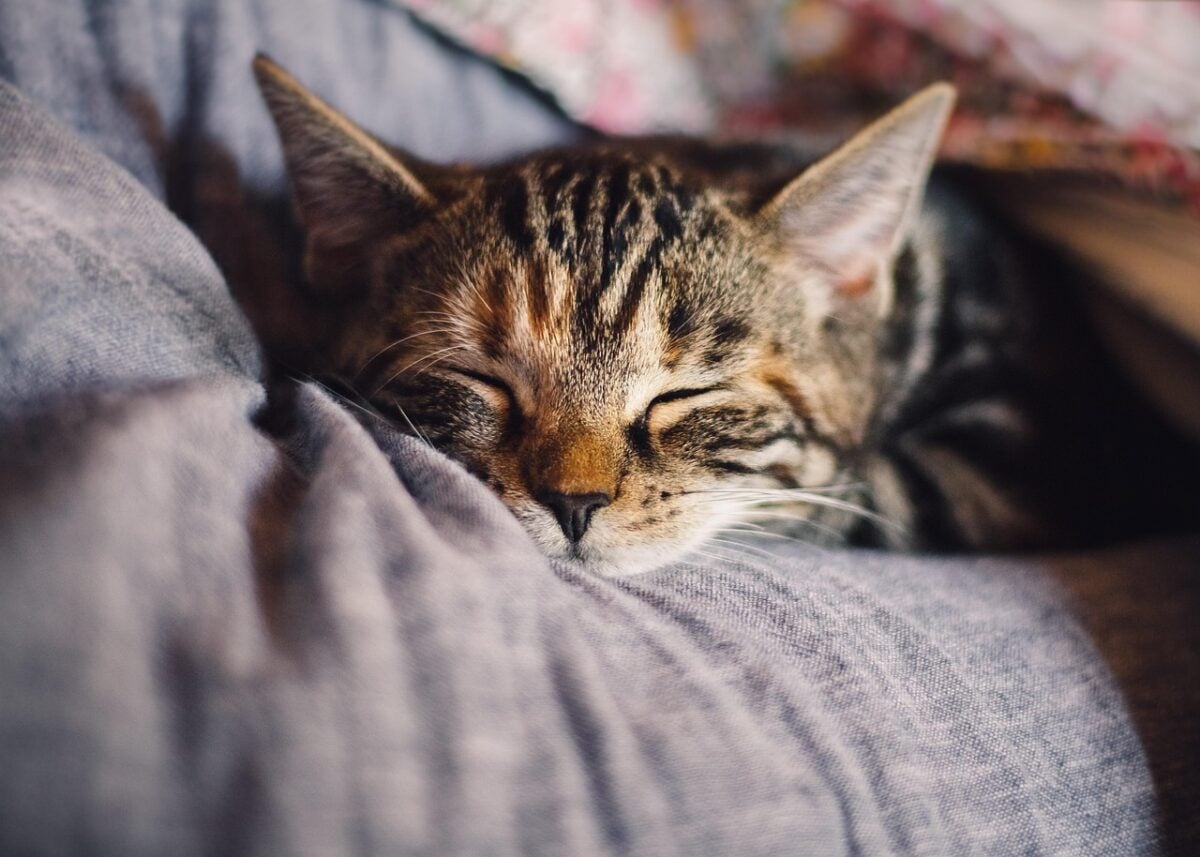
Cats rarely hand us a behavior with a neat little translation attached. The same action can mean different things depending on when it happens, what came before it, and what your cat does next.
A cat rubbing enthusiastically against your legs when you walk through the door is giving you a very different set of clues than one doing it every morning while escorting you toward an empty food bowl.
When you’re trying to decode a behavior, look beyond the behavior itself:
- When does it happen? Before meals, when you get home, at bedtime, or seemingly out of nowhere?
- What happened first? A loud noise, a visitor, another pet entering the room—or the unmistakable sound of the refrigerator opening?
- What does the rest of your cat look like? A loose, relaxed body tells a different story than flattened ears, a twitching tail, or obvious tension.
- Is it new? A sudden change from your cat’s normal habits can be more revealing than the behavior itself.
- What happens next? Do they settle beside you, lead you somewhere, keep asking for attention, or escalate their efforts?
10 Cat Behaviors That Look Like Love — And What Else They Can Mean
Some of your cat’s most endearing habits really are rooted in affection. They’re just not always only about affection. From stealing your body heat to keeping tabs on the household schedule, another layer often hides beneath the adorable exterior.
Here are 10 familiar behaviors that get much more interesting once you know what else might be going on.
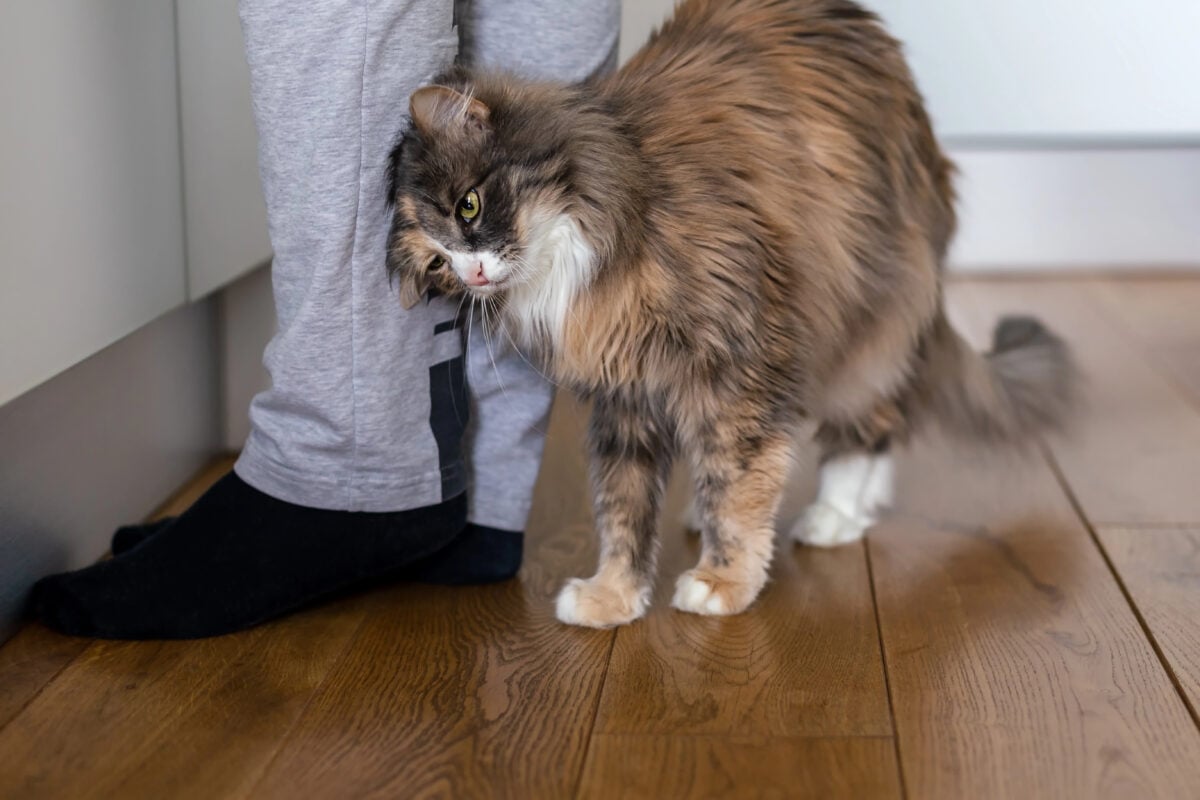
1. Rubbing Against Your Legs: “You’re Mine” Is More Literal Than You Think
When your cat winds around your ankles the moment you walk through the door, affection may absolutely be part of the greeting. It’s very sweet, right up until you’re trying to cross the room carrying groceries while your cat turns your lower legs into an obstacle course.
But some chemical communication is happening down there, too.
Cats have scent glands around their cheeks, chin, forehead, and other parts of the body. When they rub against you, they can leave behind chemical signals called pheromones.
That scent communication can serve a few purposes:
- Creating familiarity: Your scent becomes part of the familiar environment your cat recognizes as home.
- Reinforcing social bonds: Cats may rub against other cats they’re comfortable with, not just their humans.
- Refreshing familiar scents: After you’ve been away, you come home carrying smells from other people, places, and possibly animals.
So that elaborate welcome-home routine may have another layer. You thought you were receiving an emotional homecoming. You may also be undergoing customs inspection.
And although you’ll sometimes hear that a rubbing cat is “claiming you as their territory,” that’s a little too simplistic.
Friendly cats rub against one another, too, particularly around the head and face. With familiar individuals, scent exchange helps maintain a recognizable social environment rather than simply planting a feline ownership flag.
What matters more is whether the behavior looks normal for your cat.
Relaxed rubbing with an upright tail and loose body fits comfortably into a friendly greeting. Rubbing that suddenly becomes unusually frantic, persistent, or frequent, especially alongside vocalizing, agitation, appetite changes, or other new behavior, is a change worth noticing.
2. Sleeping Pressed Against You: You May Be Loved… And Thermally Convenient
A cat choosing to sleep pressed against your side is a pretty meaningful vote of confidence. Sleep leaves cats vulnerable, so settling deeply beside you suggests they feel safe enough to let their guard down.
But you also have another highly desirable quality: you’re warm.

Cats naturally seek out comfortable, heat-retaining places to sleep. That’s why the same animal who has access to three expensive cat beds may choose the patch of afternoon sunlight, the warm laundry straight from the dryer, or the exact spot where you were sitting 30 seconds ago.
Sleeping against you offers several perks at once:
- Body heat: You’re essentially a large, self-heating cat bed.
- Familiar scent: You smell like part of their safe, known environment.
- Security: A trusted sleeping companion can make a resting spot feel safer.
- Predictability: You’re generally easier to sleep beside than another animal that might suddenly decide it’s wrestling time.
You may notice this arrangement becomes considerably more popular once the temperature drops. A cat who spends July sleeping three feet away can become remarkably committed to the relationship in January.
Apparently, nothing rekindles romance like central heating that comes with a pulse.
3. Kneading You: That Adorable Massage Has Ancient Baggage
When your cat climbs onto your lap and starts rhythmically pressing their paws into you, contentment is a very reasonable interpretation. Unfortunately, contentment sometimes arrives as eight pounds of cat concentrating its entire body weight into four tiny pressure points.

Kneading starts remarkably early. Kittens press their paws around their mother’s mammary glands while nursing, which helps stimulate milk flow. Many cats carry the movement into adulthood long after milk is out of the equation.
For an adult cat, kneading can become part of a familiar relaxation and settling routine. You may see it:
- Before sleep, as your cat prepares a comfortable spot.
- On soft surfaces such as blankets, pillows, cat beds, and conveniently available human stomachs.
- During relaxed interactions, particularly when they’re already comfortable and winding down.
Some cats even purr, drool, or become especially zoned out while kneading, which fits with its connection to an early, deeply familiar comfort behavior.
What matters is whether it fits your cat’s normal pattern. Occasional kneading while relaxed is very different from a sudden increase in persistent kneading accompanied by restlessness, hiding, excessive grooming, vocalizing, or other signs of stress.
4. Licking You: There’s More Behind Those Sandpaper Kisses
A few deliberate licks on your hand, arm, face, or hair can certainly feel like feline kisses. From your cat’s perspective, though, you may simply be the strangest member of the grooming circle.
Cats that have friendly social relationships may groom one another, a behavior known as allogrooming. It can help maintain social bonds and often focuses on areas such as the head and neck. Some cats extend that treatment to their humans, despite our obvious shortage of fur.

But sometimes you also taste or smell interesting. Your cat might be investigating:
- Salt on your skin, particularly after you’ve been sweating.
- Shampoo, lotion, or other unfamiliar scents lingering on your hair or body.
- Food smells left behind on your hands.
- Your reaction. If licking reliably earns talking, petting, laughing, or attention, your cat may learn that it’s an effective way to get you involved.
Brief, relaxed licking that fits your cat’s usual behavior generally isn’t concerning. Pay more attention if licking suddenly becomes intense, difficult to interrupt, or repetitive enough that your cat seems unable to settle without doing it. We’ll get into sudden changes in affectionate behavior and what they can signal later.
Also, be more cautious when you’ve applied something to your skin or hair. Some topical medications, essential oils, creams, and personal-care products can be unsafe for cats to ingest, so don’t let your cat lick treated areas unless you know the product is cat-safe.
5. Following You Everywhere: Sometimes You’re A Person. Sometimes You’re A Schedule.
Your cat gets up when you get up. Trails you into the kitchen. Appears in the bathroom. Supervises whatever you’re doing in the bedroom. It’s easy to assume they simply can’t stand being apart from you.
Maybe. But your cat may also be keeping tabs on the most useful source of information in the house: you.
Cats are remarkably good at learning routines and noticing which human actions predict something worth investigating. Over time, seemingly meaningless movements can become reliable clues:
- You stand up from your desk: Something may be happening in the kitchen.
- The laptop closes: Dinner could be approaching.
- You head toward the bathroom: The faucet might become available.
- A particular cabinet opens: Treats have historically emerged from this location.
- You start getting ready for bed: A favorite nighttime routine is about to begin.
Your cat doesn’t need to understand why you do these things. They only need to learn what tends to happen next.
That’s what makes following different from simply demanding attention. Sometimes your cat isn’t asking for anything yet. They’re tracking the household’s most useful moving variable because wherever you go, interesting things have an uncanny tendency to happen.
Apparently, you’ve become less of a person and more of a very elaborate push notification.
6. Sitting On Your Stuff: Your Laptop May Simply Be Better Than You
You’ve purchased beds. Blankets. Possibly an entire piece of furniture marketed specifically toward cats.
And yet your cat wants your laptop, your book, your clean laundry, your half-packed suitcase, or the one sheet of paper you need right now.
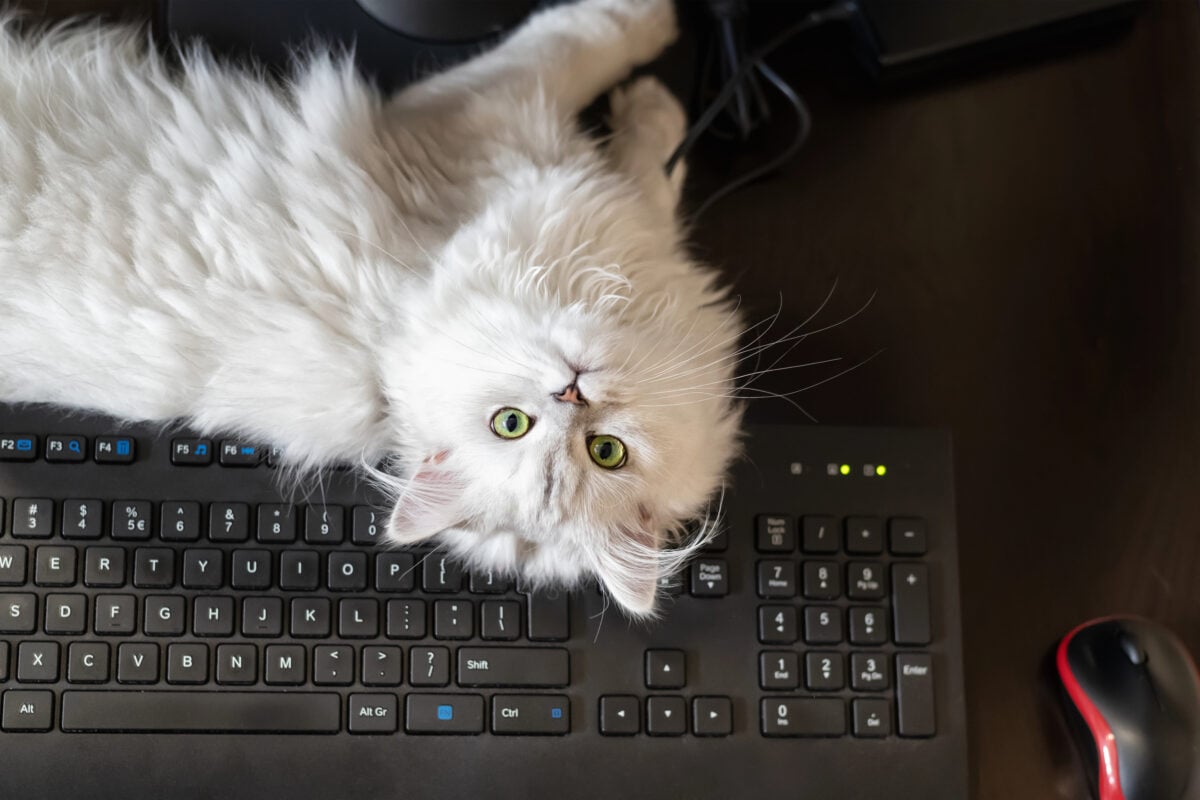
Wanting to be near you may be part of the appeal, but these objects come with their own impressive list of amenities:
- Your scent: Clothes, bedding, bags, and frequently handled objects smell familiar.
- Warmth: A recently used laptop or the spot you just vacated can be prime cat real estate.
- Novelty: Put a new box, bag, book, or suitcase in familiar territory, and you’ve created something that demands investigation.
- Location: The object you’re using is usually conveniently positioned right beside you.
- Your undivided attention: This is where things get interesting.
If sitting beside the laptop gets ignored but sitting directly on the keyboard makes you immediately look over, speak, touch your cat, or attempt diplomatic negotiations, your cat has just learned which option works better.
Behavior that produces a useful result is more likely to be repeated. Your cat doesn’t need a sophisticated plan to manipulate you; they just need to notice that the keyboard has an excellent response rate.
Your Cat May Have Assigned Everyone A Job
Live with other people? Your cat may have assigned everyone a role without bothering to hold interviews.
One person becomes the preferred lap, another gets recruited for play, and someone else is apparently responsible for breakfast, doors, faucets, or reassurance when the vacuum cleaner commits another atrocity.
Cats can learn which people reliably provide particular experiences, so the person they cuddle most isn’t necessarily the only one they share a strong relationship with.
You may not be the designated snuggle person. You could hold the equally prestigious title of Senior Vice President of Wand Toy Operations.
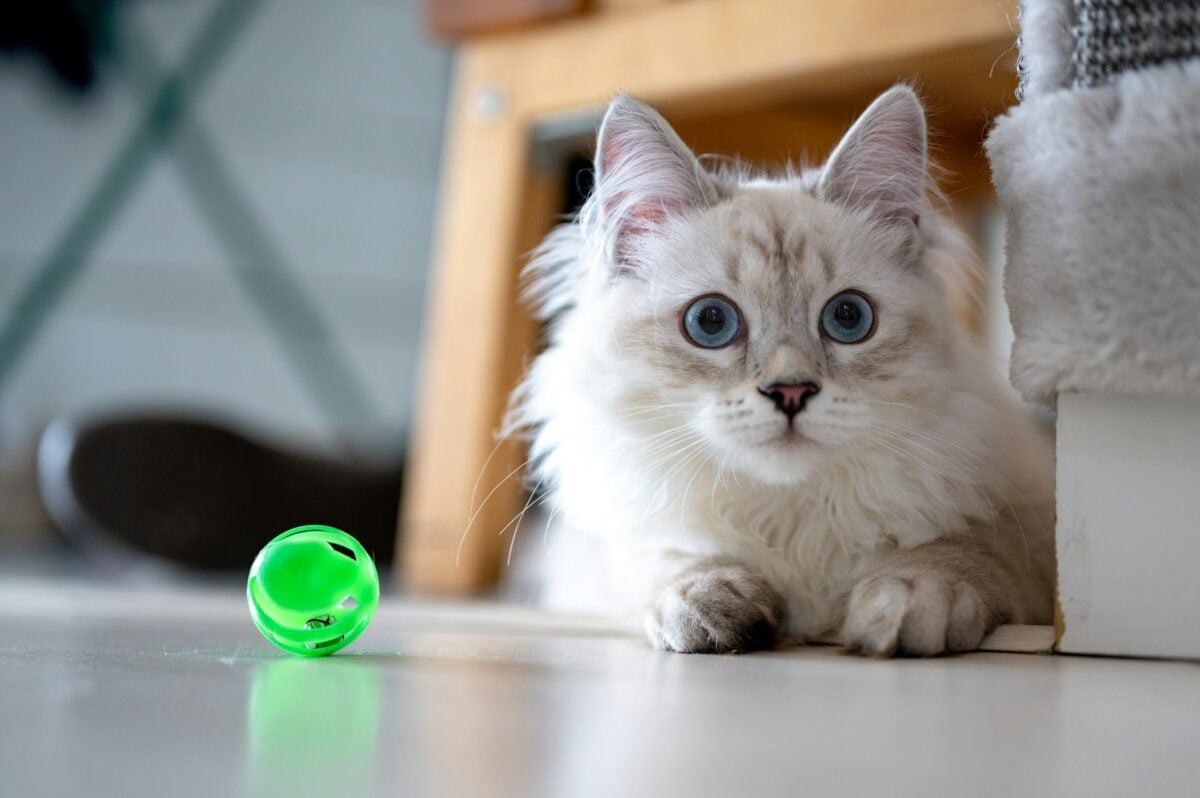
7. Bringing You Toys: Your Cat May Be Starting Something
It’s hard not to feel a little special when your cat trots into the room carrying a favorite mouse and deposits it at your feet. A gift! For you!
Possibly. But your cat may be less interested in giving you something than in getting something started.
Stalking, chasing, grabbing, carrying, and batting objects are all connected to the predatory behaviors that show up in feline play. A toy delivered to you can become part of that sequence, especially if you’ve taught your cat, intentionally or otherwise, that toy delivery makes the human come alive.
Watch what happens after the drop-off:
- They stare at you or the toy: You may be expected to make the next move.
- They become animated when you pick it up: The delivery may be a play invitation.
- They repeatedly bring it back: Congratulations, you may own a cat who has invented fetch.
- They walk away: The object itself may have been more interesting than your participation.
Real prey is more complicated. The popular claim that cats bring dead animals home because they think their humans are hopeless hunters who need feeding makes a great story, but we can’t confidently assign that specific motive.
With toys, though, repeated delivery followed by obvious excitement when you engage is a pretty good clue: you’ve been recruited.
8. Purring: The Sound Of Happiness Isn’t Happiness-Only
Few sounds are more satisfying than a cat purring against you. Content cats absolutely do purr, and when yours is sprawled across your lap with a loose body and half-closed eyes, happiness is a pretty reasonable interpretation.
But purring has a much wider emotional range than its reputation suggests.
Cats may also purr when they’re frightened, stressed, in pain, or otherwise uncomfortable. You might hear it during a veterinary exam, after an injury, or when a cat isn’t feeling well.
In those situations, researchers and veterinarians have proposed that purring may have a self-soothing or communicative function, although we don’t fully understand every reason cats do it.
The sound itself, then, isn’t enough to tell you how your cat feels. Look at what accompanies it:
- Relaxed body, normal appetite, familiar routine: More consistent with ordinary contentment.
- Hiding, crouching, tension, or unusual withdrawal: The purring shouldn’t automatically be read as happiness.
- Reduced appetite, mobility changes, sensitivity to touch, or other signs of discomfort: Pay attention to the bigger behavioral change.
The especially important clue is a change from your cat’s normal purring pattern. If a cat who rarely purrs suddenly does it persistently while hiding or acting unwell, the familiar happy sound can become part of a very different picture.
9. Slow Blinking: This One Really Is Pretty Sweet — Usually
The slow blink has earned a charming nickname among cat owners: the “cat kiss.” There may actually be something to our enthusiasm for it, although “kiss” is putting a very human translation on feline behavior.
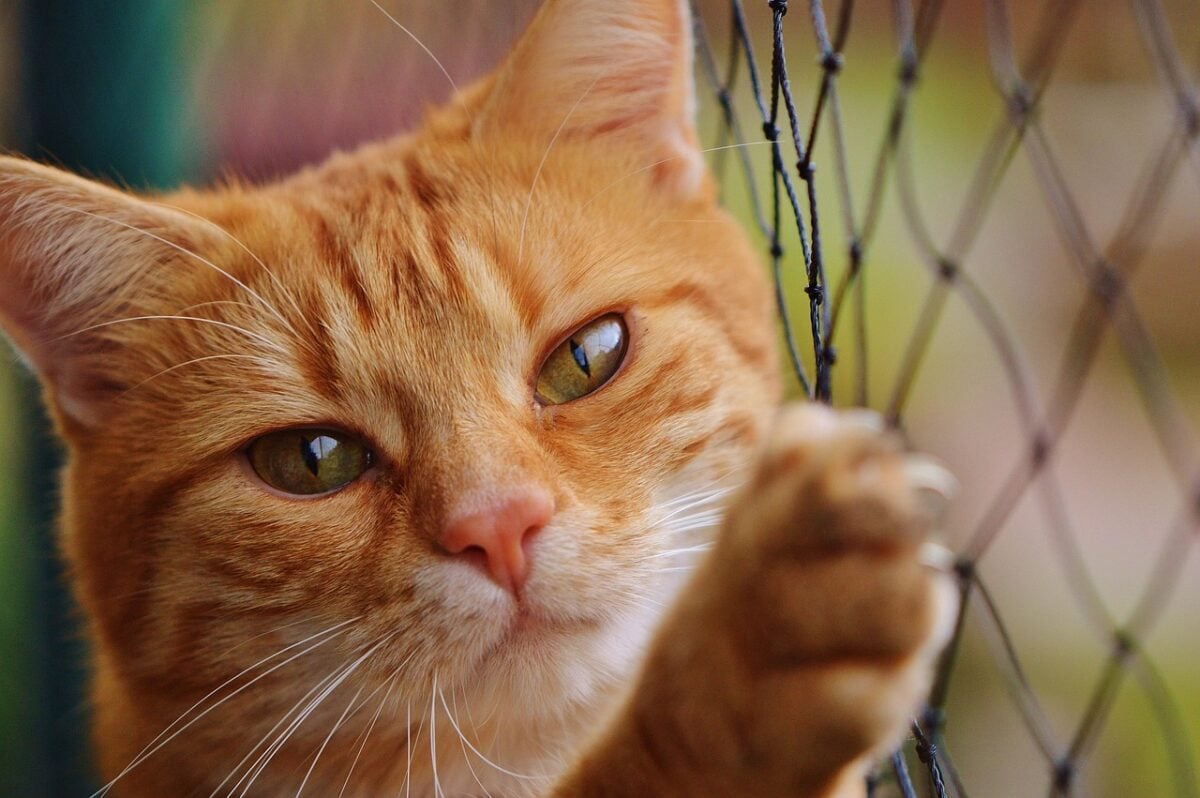
Research into cat-human interactions has found that cats may narrow their eyes and slow blink more after humans slow blink at them, and cats in the 2020 study were also more likely to approach a person after that kind of interaction.
Rather than translating every long blink into “I love you,” think of it as a sign that your cat is comfortable enough around you to lower their guard. A relaxed cat doesn’t need to keep its eyes wide and constantly monitor you for trouble.
And from an animal that can treat the arrival of a cardboard box as an event requiring a full security assessment, that’s a pretty nice compliment.
Try returning the gesture. Soften your expression, slowly narrow or close your eyes, then open them again rather than staring directly at your cat.
They may blink back, look away, approach you — or demonstrate their independence by doing absolutely nothing.
10. Pawing At You: Your Cat Has Discovered The Customer-Service Button
A cat gently placing one paw on your arm can feel almost absurdly tender. Then they do it again. And again. Perhaps with slightly more claw this time.
Your cat may be communicating, not just cuddling.
A paw is remarkably effective at getting a distracted human to respond. Cats can use gentle touches, taps, reaching, or increasingly determined pokes to initiate an interaction, and they can become very good at learning which version gets results.
The sequence might look suspiciously familiar:
- Paw touches human: Human looks over.
- Second tap: Human starts talking.
- More determined tap: Petting begins.
- Tap followed by a pointed stare toward the kitchen: Human finally understands the assignment.
Once a particular approach reliably works, your cat has little reason to abandon a perfectly functional system.
Some cats even escalate when the polite version fails. A soft paw becomes repeated tapping, climbing onto you, vocalizing, or positioning themselves directly between your face and whatever has somehow become more important than them.
You may think you’re responding to your cat’s requests. Your cat may be conducting ongoing usability testing.
Affection Has An Off Switch, Too
Cats don’t just tell us when they want interaction. They also tell us when they’ve had enough, although humans have an impressive habit of missing the early memos.
A cat that climbed into your lap voluntarily may still reach a point where petting stops feeling good. Before a swat, nip, hiss, or dramatic departure, you may notice subtler changes:
- The tail starts flicking or thumping
- The skin along the back twitches
- The ears rotate sideways or backward
- Your cat turns toward your hand
- Their body becomes more tense
- They shift away or reposition themselves
These signals don’t erase the fact that your cat chose the interaction in the first place. They tell you that the terms of the interaction have changed.
Your cat may have requested cuddles. They did not necessarily select the unlimited data plan.
What If Your Cat Doesn’t Do Any Of These?
Maybe your cat doesn’t knead you, lick your face, sleep on your chest, or follow you into every room. That doesn’t make your relationship the feline equivalent of a loveless marriage.
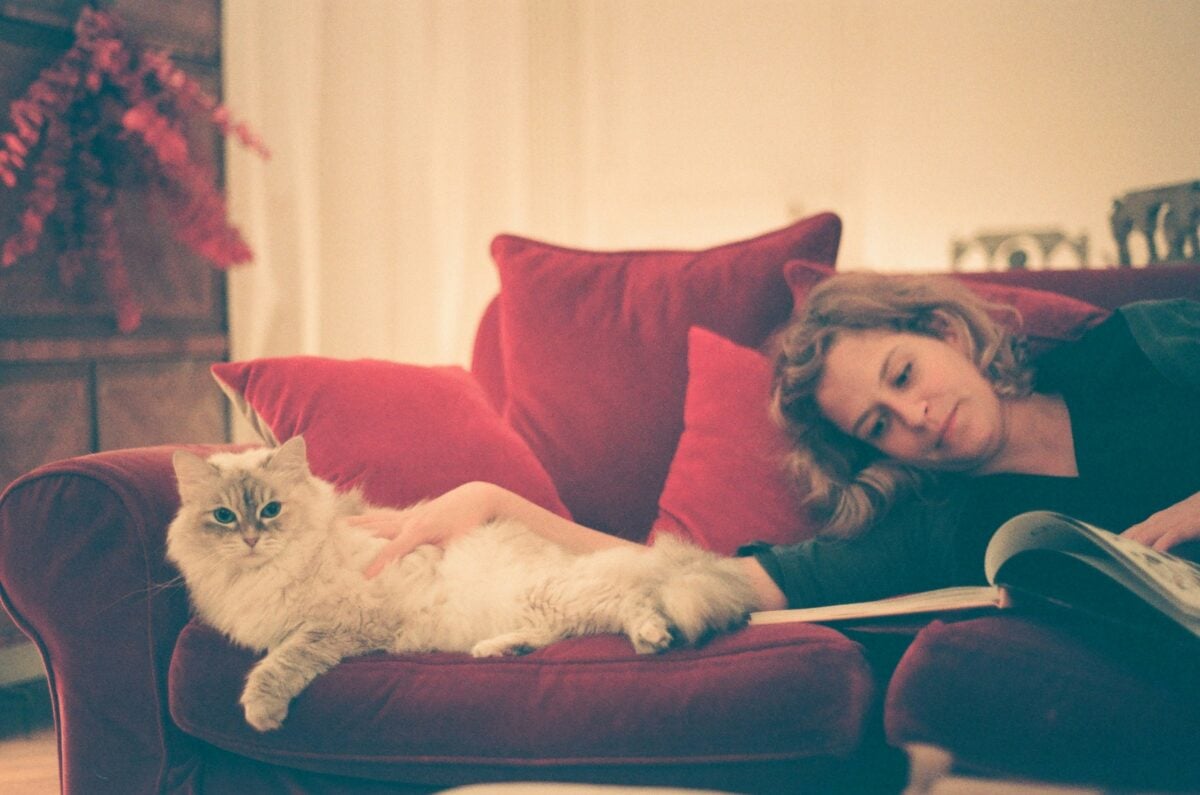
Cats vary enormously in how much physical contact they enjoy and how visibly they seek social interaction. Temperament, early experiences with people, socialization, and previous interactions can all influence how a cat behaves around humans.
Some cats prefer proximity without much physical contact. Their version of seeking you out might look more like:
- Sleeping at the opposite end of the couch
- Choosing a perch in whatever room you’re using
- Appearing nearby when you settle down
- Watching what you’re doing without joining in
- Approaching for short interactions and leaving on their own terms
For a cat like this, choosing to share space can be meaningful social behavior even if they’re never going to drape themselves around your neck like a furry travel pillow.
Comparing that cat with an extremely demonstrative one can obscure the more useful question: Has your cat chosen ways of being around you that fit their personality?
When “Affection” Is Really Your Cat Asking For Something
Here’s where cat behavior gets especially interesting: wanting something from you doesn’t make the interaction less genuine.
Cats learn who controls important resources, who responds when they initiate contact, and who feels safe when something isn’t right. If your cat comes looking for you when they need something, the need may be driving the behavior, but their choice of person can still tell you something about the relationship.
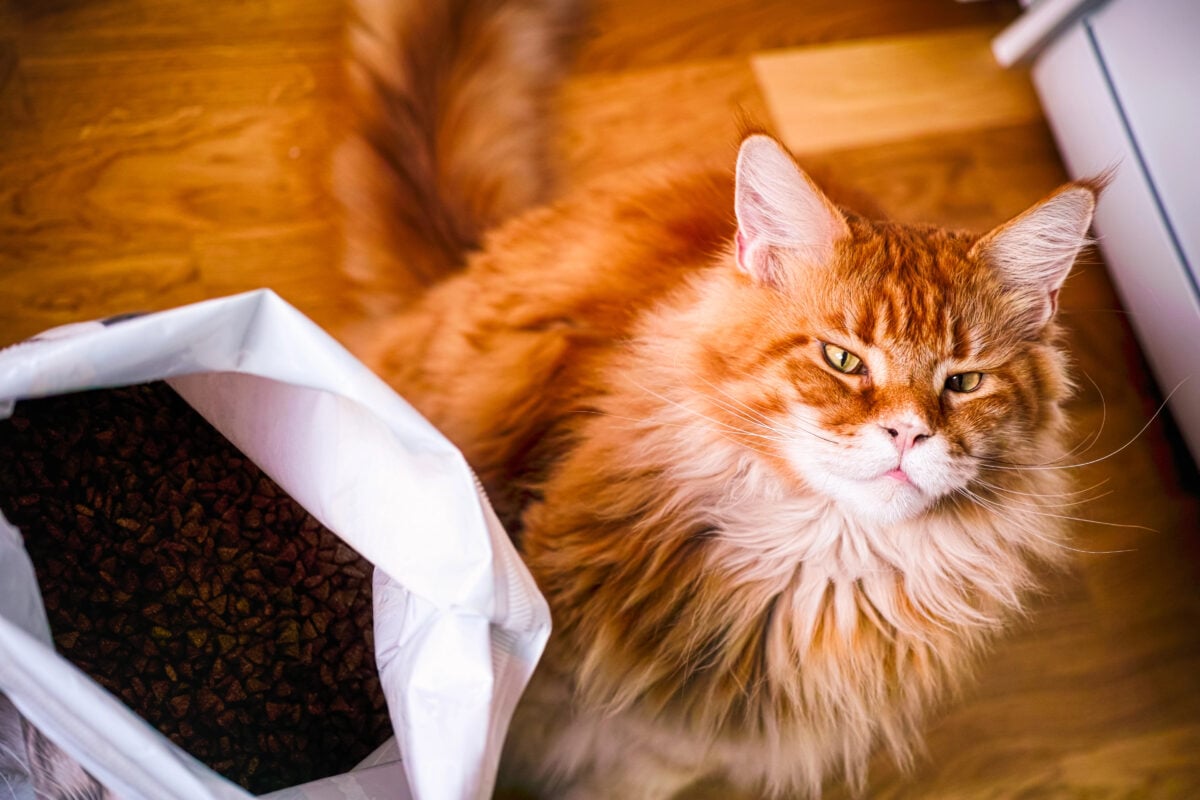
What they’re seeking might be:
- Food: Some cats develop remarkably specific pre-meal routines involving extra rubbing, following, or vocalizing.
- Attention or play: If interaction with you reliably turns a boring afternoon into something interesting, you’re a valuable resource.
- Warmth: Cooler temperatures can suddenly make physical closeness much more appealing.
- Security: A frightening noise, visitor, household change, or conflict with another pet may send a cat toward someone they trust.
- Routine: Cats can become attached to predictable interactions that happen at particular times or after particular cues.
- Enrichment: A cat without enough opportunities to play, explore, climb, hunt, or investigate may seek more interaction from you simply because you’re the most interesting thing available.
That last possibility is especially worth noticing. A cat who suddenly becomes relentless about getting your attention may not need more cuddling so much as something engaging to do.
Food puzzles, climbing spaces, short interactive play sessions, rotating toys, and opportunities to watch or investigate the world give that energy somewhere else to go.
Mittens isn’t necessarily running an 11-year emotional con. You may simply be the person they’ve learned can make things happen.
The Bigger Clue Isn’t What Your Cat Does — It’s What Changed
After decoding all these individual behaviors, there’s one clue that can matter more than any of them: Is this normal for your cat?

A cat who has slept on your pillow every night for eight years probably isn’t sending up a new behavioral red flag. But if your fiercely independent cat suddenly starts following you everywhere, sleeping pressed against you, and demanding constant contact, the change itself deserves attention.
The reverse matters, too. A cat who normally meets you at the door, sleeps beside you, and regularly seeks contact may suddenly start hiding or avoiding interaction when they don’t feel well.
Pain, illness, stress, household disruptions, and age-related changes can all affect how cats interact with their people. Watch more closely when a noticeable social change appears alongside these symptoms.
- New or excessive vocalizing
- Hiding or unusual withdrawal
- Eating or drinking more or less than usual
- Restlessness or difficulty settling
- Litter box changes
- Reluctance to jump, climb, or move normally
- Changes in grooming habits
- Sensitivity to touch or other signs of pain
- Changes in normal sleep patterns
- Confusion or disorientation, particularly in older cats
You don’t need to diagnose the cause from your couch. A new behavior plus other changes gives your veterinarian much more useful information than “my cat is acting weird.” Note when it started, what else changed, and whether it’s becoming more frequent.
When Behavioral Changes Lead To Expensive Vet Bills
Sometimes figuring out why a cat’s behavior changed takes more than a routine exam. Bloodwork, urine testing, X-rays, ultrasounds, or other diagnostics can add up quickly, especially when the cause isn’t immediately obvious.
That’s where having pet insurance before something changes can matter. Most policies don’t cover pre-existing conditions, so buying coverage after your cat develops unexplained symptoms may mean that particular problem — and related treatment — is excluded.
If you’re considering coverage, check out our guide to the best pet insurance companies to compare providers, coverage, costs, and exclusions before you choose a policy.
Frequently Asked Questions
Affection doesn’t look the same in every cat—or even from the same cat in every situation. These questions cover some of the variables we haven’t addressed yet. Have a behavior we haven’t covered? Ask us about it in the comments below.
Why Is My Cat More Affectionate With Me Than Other People?
Cats can develop different relationships with different people in the same household. Your scent, voice, handling style, daily routines, and history of positive interactions can all influence who a cat seeks out.
The person who feeds the cat isn’t automatically the favorite, either. Some cats gravitate toward whoever is most predictable, respects their boundaries, or interacts with them in ways they enjoy.
Why Does My Cat Get More Affectionate At Night?
Nighttime can reduce the competition for your cat’s attention. The house is calmer, you’re finally sitting still, and familiar bedtime routines are beginning. Your bed also happens to be soft, warm, and conveniently occupied by someone your cat knows.
Do Cats Become More Affectionate As They Get Older?
Some do, but becoming clingier isn’t an inevitable part of aging. An older cat may seek more warmth, familiar routines, or proximity to a trusted person, particularly as mobility, hearing, or vision changes.
A significant change in sociability — either becoming unusually clingy or suddenly withdrawing — is worth mentioning to your veterinarian, especially if other behaviors have changed too.
Can A Cat Be Affectionate Without Liking To Be Held?
Absolutely. Physical restraint and social affection aren’t the same thing. A cat may follow you, sleep nearby, rub against you, initiate play, or choose to spend much of the day in your company while strongly objecting to being picked up. Some cats simply prefer to control when contact begins and ends.
Why Does My Cat Sit Near Me But Not On Me?
For some cats, being nearby is the preferred form of social contact. They may enjoy your company while also wanting control over their space, temperature, and ability to move away whenever they choose.
Pay attention to the pattern. A cat who repeatedly chooses the same room, settles beside you on the couch, or relocates when you relocate is actively choosing proximity, even if your lap remains firmly off-limits. In cat terms, hanging out three feet away can be a perfectly deliberate social decision.
Keep Decoding What Your Cat Is Telling You
Once you start noticing when, why, and how your cat seeks you out, those supposedly mysterious behaviors get a lot more interesting. One habit rarely tells the whole story, but the patterns can reveal plenty about trust, attachment, routine, and what your cat has learned about life with you.
Want to keep decoding your relationship?
- How To Tell If Your Cat Loves You… Or Just Wants The Warm Spot On The Couch — Look at the broader signs that affection and trust are genuinely part of your cat’s behavior.
- The Chosen One: 15 Signs Your Cat Has Imprinted On You — See what it looks like when your cat forms an especially strong bond with one person.
- Wondering “Why Is My Cat So Clingy?” This Explains Everything — Dig deeper if your cat’s desire to stay close seems to be moving beyond ordinary affection.
- 10 Signs Your Cat Is Stressed But Hiding It — Learn which subtle changes can suggest that extra closeness, withdrawal, or other unusual behavior deserves a second look.
What’s the one thing your cat does that you’re absolutely convinced means “I love you”? Share your cat’s quirky behavior in our comments.