When you purchase through links on our site, we may earn a commission at no extra cost to you. Learn more.
Do you talk to your cat throughout the day? Most cat owners do. Whether it’s narrating dinner prep, offering encouragement during a nap, or casually asking why they’re sitting in the sink again, talking to our cats feels natural.
Table of Contents
But do cats actually enjoy hearing us talk? Or are we just filling the silence for our own comfort?
Science suggests it’s not just noise to them. Cats can recognize familiar human voices, respond to tone and pitch, and in some situations, even find those sounds calming. Understanding how your cat hears you can strengthen your bond, reduce stress, and help you communicate more effectively.

Yes, I Talk to My Cats All Day, And They Definitely Talk Back
I talk to my cats all day long. Whether I’m working, cooking, or folding laundry, there’s a running commentary—and yes, they’re part of it. I ask them what they think of my outfit, I narrate their lunch, and I’ve regularly caught myself saying things like, “Excuse me, sir, that’s not your chair.”
Want our human-written content to rank above AI-generated garbage? Help us out by clicking this button!
The best part? They respond. One of my cats meows back almost every time I speak, like he’s keeping up his end of the conversation. Another will blink slowly or come curl up next to me as I ramble on.
They know my tone, they know when I’m happy or stressed, and sometimes, I swear they know when I need company. It’s a quiet but constant form of connection, making the house feel a little less quiet and a lot more like home.
What Your Cat Hears When You Talk
It might seem like your cat ignores you on purpose, and to be fair, sometimes they do. But don’t mistake that aloofness for indifference. Cats do recognize human voices, and research confirms they’re especially tuned in to the voices they know best.

A 2013 study at the University of Tokyo found that cats can distinguish their owner’s voice from those of strangers. In the study, researchers played recordings of strangers’ voices followed by the owner’s voice, all calling the cat by name.
The cats responded most noticeably through ear movements, tail flicks, and pupil dilation to their owner’s voice. The twist? Most didn’t actually move toward the sound. That’s classic cat behavior: recognition without obligation.
This selective response is part of what makes feline communication a unique phenomenon. While dogs were bred for obedience and teamwork, cats evolved as largely independent creatures. They hear us just fine; they’re just not always interested in responding on command.
Voice recognition in cats also overlaps with how we speak to them. Linguistic research into “pet-directed speech” (PDS) shows that humans naturally shift into a higher pitch, slower tempo, and sing-song tone when addressing animals, especially pets we feel emotionally close to.
This is similar to “infant-directed speech” (IDS), the kind of melodic speech adults use with babies. A 2022 study from Université Paris Nanterre (Saito et al.) found that cats were more responsive to their owner’s voice when it was directed specifically at them rather than when the owner was talking to another person.
The study also found that cats responded more strongly to their owners’ PDS than strangers, showing both recognition and a preference for familiar vocal patterns. This suggests cats can not only identify who is speaking but also who the speech is intended for, adding a layer of social awareness we often underestimate.
Kittens, in particular, appear more responsive to high-pitched “kitten-directed speech.” As they grow, some cats may become less reactive to baby talk. In contrast, others still find it comforting well into adulthood, especially in homes where humans continue to use that affectionate tone.
So, while cats may not always react with tail wags or excited barks, make no mistake: they hear you. They recognize you. And your voice is a meaningful part of their world, even if they choose to show it in subtle, feline-appropriate ways.
Watch: People Who Seriously Talk to Their Cats (And the Cats Who Talk Back)
Sure, your cat might look completely unimpressed when you tell them they’re perfect—but deep down, they might actually love it. Compliments, cooing, and even the occasional silly nickname can all become part of how your cat connects with you. And as strange as it may seem, you’re definitely not the only one narrating your life to a feline friend.
Want proof? Check out this hilarious and heartwarming video of cat parents chatting it up with their kitties, complete with full conversations, dramatic monologues, and some truly iconic meow-backs.
It’s feline communication at its finest… or weirdest. Either way, you’ll feel seen.
Do Cats Understand Words or Just Vibes?
Your cat probably doesn’t understand your full sentences, but that doesn’t mean they aren’t listening. Research indicates that cats recognize specific sounds, particularly those associated with routines.
A 2019 study found that cats can distinguish their names from other words, even when spoken by strangers. They just may not respond unless they feel like it. So far, research has yet to prove that specific words in the human language have special meaning to cats.
Cats learn by association, not language. If “treats,” “dinner,” or their name consistently lead to food or attention, they’ll learn to pay attention to those cues.
They’re not parsing grammar. They’re reading patterns. Your tone, pitch, facial expressions, and body language matter as much (if not more) than the words themselves.
In fact, to a cat, our words are a bit like their meows are to us. We don’t speak “cat,” but we can often tell the difference between a “feed me” meow, a “hello” meow, and a “something’s wrong” meow. Likewise, cats may not understand the full sentence “I’ll be back in five minutes, sweetie,” but they pick up on the emotional tone, pacing, and familiar rhythms in your speech.
It’s also important to understand that cats don’t meow much to each other past kittenhood. Meowing is a communication tool they reserve primarily for us. It’s a language they’ve developed to interact with humans, and in return, they learn to interpret our “language” through tone and routine rather than vocabulary.
So, your cat probably doesn’t understand that you’re venting about your boss. But they know that your soothing voice means everything’s okay, that “snack time” means food is coming, and that their name usually leads to something worth investigating. In short, cats are masters of vibe recognition, and if you’re consistent, they’ll learn your patterns, even if they don’t speak your language.
Cats also use plenty of nonverbal signals to get their message across.
A raised, gently curved tail can be a friendly greeting. Rubbing their body against your legs marks you with their scent. It’s a feline way of saying, “You’re mine.”
And when they pounce on your socks or bring you a toy mouse, it’s often an invitation to play. Every tail twitch and nudge carries meaning if you know what to look for.
Why Your Tone Might Matter More Than Your Vocabulary
When it comes to talking with your cat, how you say something often matters more than what you say. Cats are keen observers of tone and cadence. Even if they don’t understand the actual words, they quickly pick up on emotional cues, whether you’re calm, cheerful, frustrated, or upset.
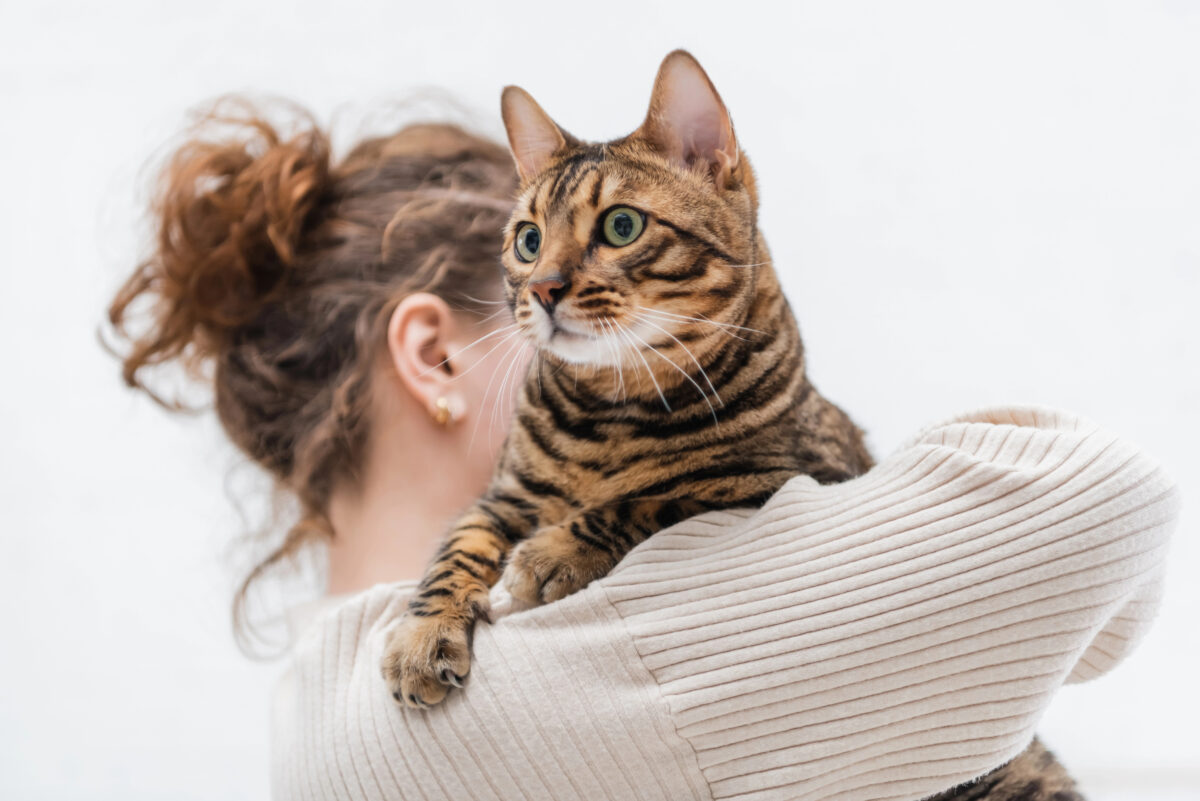
Studies have shown that cats are especially sensitive to intonation. In fact, some researchers believe that cats may even attempt to “mirror” their owner’s vocal tone when they meow back, adjusting pitch and rhythm in a form of social mimicry. It’s not just about making noise. It’s about matching the mood.
Over time, cats form associations between specific tones and their outcomes. If a particular voice brings food, affection, or play, they’ll perk up at the sound of it.
Conversely, even familiar words may be ignored if said in a harsh or aggravated tone. Cats are emotionally tuned in, and a negative tone can shut down a response faster than a closed treat jar.
Cats also respond differently to different people in the household. If one person consistently feeds them breakfast or uses a softer voice during grooming, they’ll likely develop a stronger response to that individual’s presence and vocal patterns.
So yes, your cat may ignore your carefully worded monologue about switching their kibble brand, but they’re always listening to how you say it. A warm, soothing voice can offer comfort, while a sharp one may cause them to retreat. In a cat’s world, tone really does speak louder than words.
How To Tell If Your Cat Likes The Sound Of Your Voice
Is your cat curling up closer when you talk or bolting for the nearest closet? Body language says a lot.
Look for soft blinks, kneading paws, or a slow approach when you speak. If your cat turns toward you, purrs, or even meows back, chances are they’re enjoying the sound of your voice.
And if they leave the room? Well, not everyone appreciates a monologue.
Do Cats Find Our Voices Soothing? It Could Be Their Favorite Sound
While cats may not always respond overtly to our speech, studies suggest that the sound of a familiar human voice can have a calming effect on them, particularly in stressful situations.

Research into feline responses to music has shown that cats exhibit lower stress levels when exposed to music specifically composed for their species, which often mimics the tempo and frequency of natural feline communication.
While this isn’t direct evidence about human voices, it underscores the importance of sound characteristics in influencing feline stress and comfort levels.
These findings suggest that your voice, especially when used in a gentle and familiar manner, can be a source of comfort for your cat. Observing your cat’s reactions to different tones and speech patterns can help you understand what they find soothing, enhancing the bond between you.
Talking To Your Kitten: Why Your Voice Matters
If you’ve recently brought home a kitten, congratulations! This transition is massive, especially for your new family member.
They’re adjusting to unfamiliar sounds, smells, routines, and people — all at once. During this early adjustment period, your voice becomes one of the most consistent and reassuring signals in their new world.
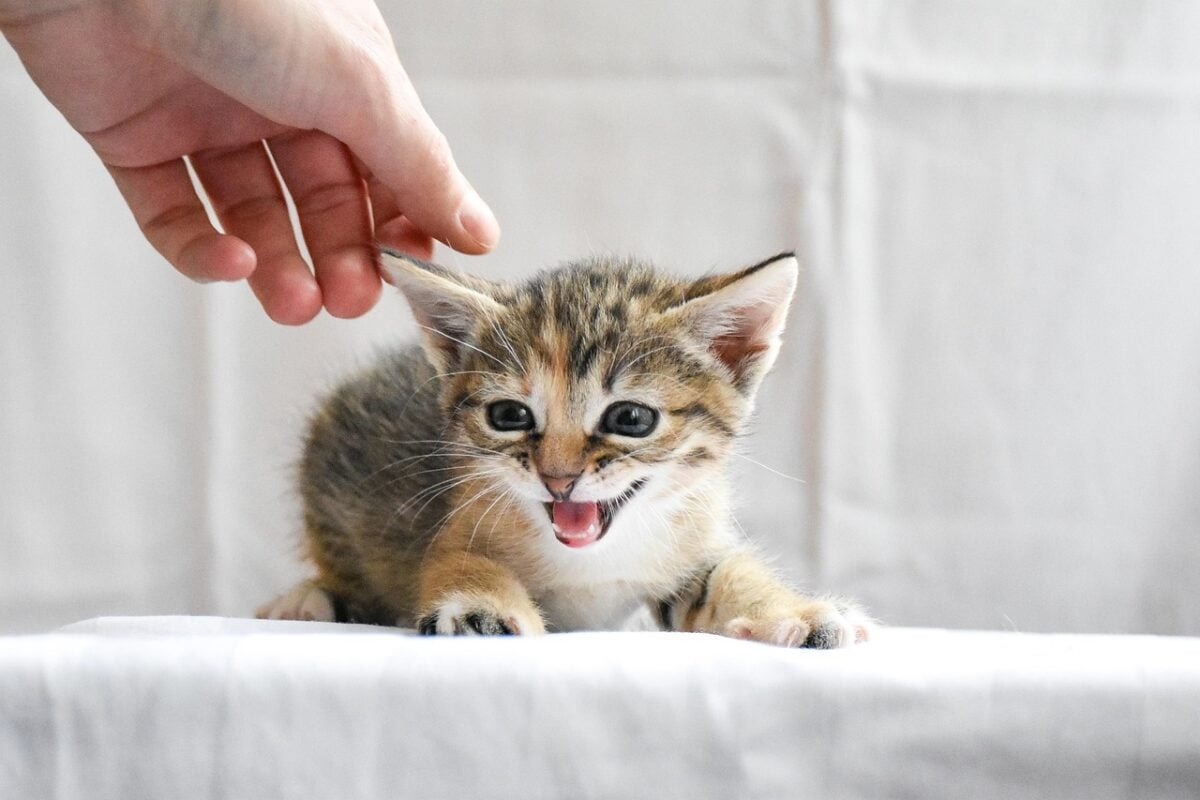
Talking to your kitten isn’t just affectionate — it plays a real role in bonding. Repeated exposure to your voice helps kittens learn who you are, what to expect from you, and when they’re safe. Over time, your tone, rhythm, and presence become part of how they regulate stress and build trust in their new environment.
Why Talking Matters So Much During A Kitten’s First Weeks At Home
Kittens experience a critical socialization window during their first few months of life. This is when they form lasting associations about safety, companionship, and communication.
Human voices — especially calm, familiar ones — often become a cornerstone of that learning process. When your kitten hears you speaking gently during feeding, play, or quiet moments, they begin to associate your voice with comfort, care, and predictability. Those early associations can influence how confident, social, and relaxed your cat feels as they grow.
How To Use Your Voice To Help A New Cat Settle In
When a cat is adjusting to a new home, consistency matters more than vocabulary. The goal isn’t to teach language but rather to create reassurance.
Helpful voice habits during adjustment periods include:
- Greeting your cat with the same calm tone each day
- Narrating routine moments like feeding or playtime
- Speaking before approaching to avoid startling them
- Using gentle praise during calm behaviors
- Avoiding loud corrections while trust is still forming
Over time, your voice becomes part of your kitten’s internal “safe map” of their environment.
Indoor Enrichment That Pairs Well With Voice Bonding
Simple ways to combine voice and play include:
- Talking during wand toy sessions to reinforce engagement
- Using a calm voice while introducing puzzle feeders
- Narrating window-watching moments to encourage relaxed observation
- Speaking softly before activating interactive toys
These small habits reinforce positive associations between stimulation, routine, and your presence.
Can Compliments Make Your Cat Purr?
It might feel a little silly to compliment your cat, but kind words can make a difference. While cats don’t understand our words the way we do, they’re highly attuned to tone. When praise is paired with something pleasant — like a treat, a head scratch, a belly rub, or a favorite toy — your voice becomes part of a positive experience.
Behavioral studies show that positive reinforcement helps shape how cats learn. A cheerful “Good kitty!” delivered with warmth and consistency can eventually prompt purring or affection, even without a reward.
Some cats are naturally more responsive, especially breeds known for being social, like Ragdolls, Siamese, or Maine Coons. Others may take more time to warm up to verbal praise, but most cats can learn to associate your kind tone with comfort and connection.
Context matters, too. Praise during play or mealtime lands much better than praise after a bath or a scolding.
Cats read the full picture: your voice, timing, and energy. So, even if your cat doesn’t strut around after a compliment, your words still matter. With the right delivery, your voice can become a trusted source of calm, care, and maybe even a purr or two.
Is Your Cat Listening When You Talk? Probably More Than You Think
Talking to your cat isn’t just something pet owners do for fun. It’s actually a form of bonding that many cats appreciate. While they may not understand every word, they recognize your voice as a familiar, comforting presence.
Although cats have a reputation for independence, many don’t actually enjoy being alone for long stretches, especially those who’ve formed strong bonds with their humans. For cats who enjoy companionship, hearing your voice can be part of what makes them feel secure.
When cats purr, rub up against your legs, or even meow back while you’re talking, they’re often positively responding to your presence. Some cats even mimic conversation, meowing as if they’re chatting right back. These behaviors are signs that your voice and your attention matter to them.
Can A Soothing Voice Really Help Your Cat Stay Calm?
Speaking to a cat in a soothing voice may have a number of benefits for their overall well-being. It may help to reduce stress and anxiety, promote relaxation and calmness, and improve the overall bond between the cat and their human.
However, it is important to remember that every cat is an individual and may have their own preferences when it comes to the sounds they find soothing. It is always a good idea to pay attention to your cat’s body language and behavior and to adjust your approach accordingly.
Do Cats Respond Differently to Men vs. Women?
Here’s a fun twist: research suggests cats may respond more consistently to women’s voices than men’s. Why? It may come down to pitch and tone.

Women often use higher frequencies and more melodic speech when talking to pets, exactly the kind of sounds cats are biologically wired to notice. But it’s not a hard rule. Plenty of cats adore deep-voiced dads, gruff grandpas, and bass-baritone roommates.
It’s less about gender and more about how someone speaks. So whether your cat prefers a falsetto serenade or a calm, low rumble, the real magic is in familiarity, gentleness, and trust.
The Science of Cat Hearing: Why High-Pitched Sounds Matter
Your cat’s ears aren’t just cute; they’re finely tuned instruments. Cats can hear sounds up to 64,000 Hz, compared to our measly 20,000 Hz range. That means they pick up on ultrasonic squeaks (like rodent calls) and the tiniest crinkles of a treat bag three rooms away.
This super-hearing also explains why cats may respond better to higher-pitched voices—especially those with a sing-song tone. Female voices, children’s voices, and exaggerated “pet talk” often fall into that frequency sweet spot.
So, if you’ve ever caught yourself pitching your voice a little higher to get your cat’s attention, your instincts were right on target.
How To Use Your Voice To Train Or Redirect Your Cat
Cats may not sit on command like dogs, but that doesn’t mean your voice can’t shape their behavior. In fact, tone consistency is one of your best tools for low-stress communication.
Use a calm, upbeat voice when calling them, a firm “ah-ah” for redirection, and a gentle tone when praising. Skip the yelling—cats don’t respond well to loud corrections and may just tune you out completely.
Voice-based training works best when paired with timing and reward. For example, saying your cat’s name in a happy voice before offering treats can help with name recognition. A consistent tone when saying “no” (or “off!”) can eventually teach boundaries, especially if it’s followed by removing the temptation or gently redirecting with a toy.
And yes, it takes patience. But if your cat now pauses mid-counter climb when they hear “Down, please,” that’s progress. Your voice just became your training clicker.
Can Cats Really Talk Back? This One Does — With Buttons
If you’ve ever wondered what your cat would say if they could speak, you’re not alone. One clever kitty has taken things to the next level, using programmed communication buttons to “talk” to their human.
Things To Consider: Why Cats Don’t All React The Same Way
No two cats are alike, and that’s part of their charm. Some cats seem to hang on to your every word, responding to their name, favorite phrases, or even tone shifts. Others give you a blank stare and walk off mid-conversation.
It doesn’t mean they don’t care. It just means they’re cats. Independent, unpredictable, and deeply individual.
When it comes to how cats respond to human voices, personality plays a big role. Some are social butterflies who thrive on interaction, while others prefer solitude and the occasional slow blink. Your cat might love your voice, or they might prefer silence and a sunny windowsill. Both are completely normal.
A common question from pet owners is: why do cats seem so much less responsive to language than dogs? The answer lies in both evolution and history.
Dogs were bred for human companionship and tasks like guarding, herding, and hunting, so communication became essential to their survival alongside us.
Cats, on the other paw, domesticated themselves. They chose to stick around because of the food, not because anyone trained them to sit or stay.
As a result, cats haven’t evolved to rely on human direction in the same way dogs have. They listen, sure, but on their own terms. Understanding this helps us appreciate their quirks rather than expecting dog-like behavior in a creature that’s built entirely differently.
One Word At A Time: How Talking To Your Cat Can Bring You Closer
In the end, it’s not about the exact words. It’s about presence, tone, and connection.
Whether you’re narrating dinner prep or offering a quiet goodnight, your voice becomes part of your cat’s world. Over time, those conversations, even if one-sided, can foster a deeper, more trusting relationship. It’s proof that love doesn’t always need to be loud to be heard.
Keep The Conversation Going: Supporting A Healthy, Vocal Cat
If you love talking to your cat, the good news is that with the proper care, they can keep “chatting” with you for years to come. Supporting their overall health is key.
Regular vet checkups, a balanced diet, daily play, and a stress-free environment contribute to their well-being. Keeping their minds engaged with interactive toys, window perches, and, yes, regular conversation can also help them stay mentally sharp and socially connected.