When you purchase through links on our site, we may earn a commission at no extra cost to you. Learn more.
The image of a cat stalking a bird is a pop-culture staple: Sylvester and Tweety, Tom and Jerry, the classic backyard chase. But outside the cartoon world, it isn’t slapstick. It’s biology.
Table of Contents
Cats are evolutionarily perfected hunters, built with hair-trigger instincts, silent movement, and sharp teeth that make backyard birds vulnerable targets. And while many pet cats now live safely indoors, millions of stray, feral, and indoor-outdoor cats still hunt daily across neighborhoods, farms, and wild spaces.
That raises an uncomfortable question for modern pet owners: how many birds do cats actually kill each year, and is it an ecological crisis?
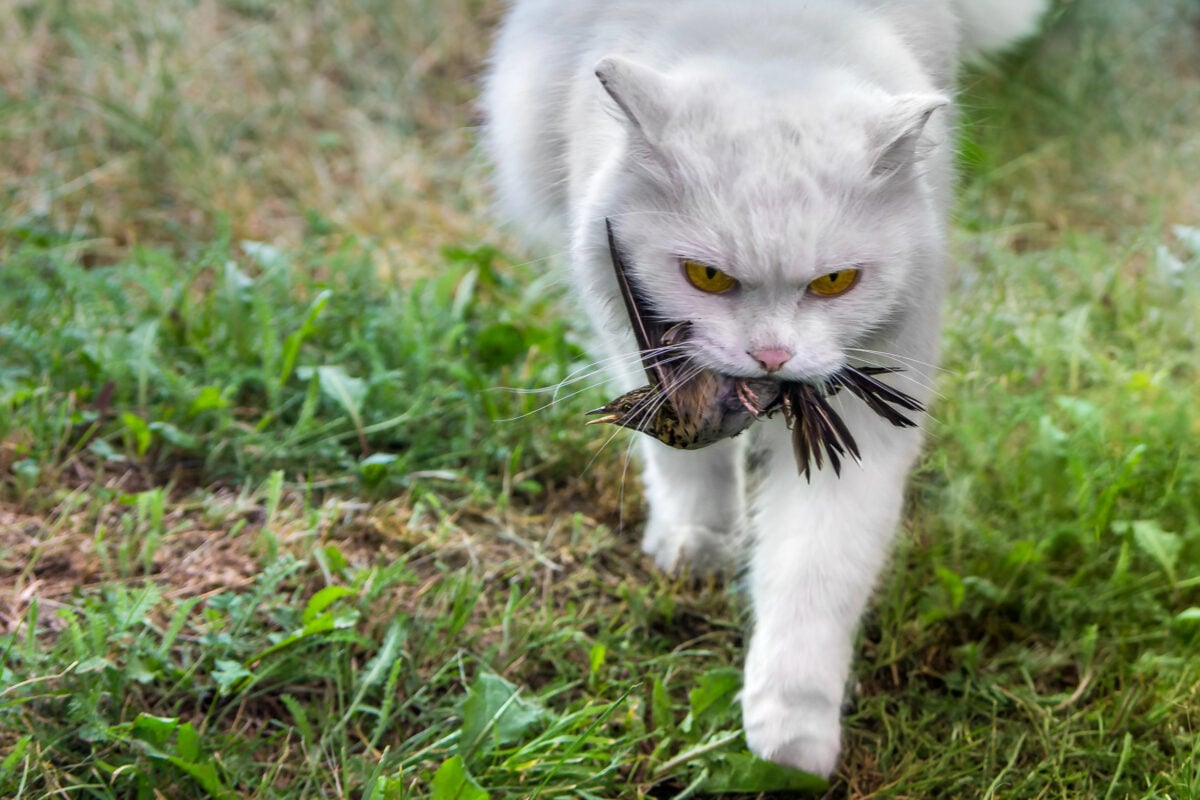
The answer is bigger than most people expect. Let’s look at the numbers, the science behind feline hunting, and the practical steps cat owners can take to protect both birds and cats.
Want our human-written content to rank above AI-generated garbage? Help us out by clicking this button!
The “Indoor Angel” vs. “Outdoor Assassin”
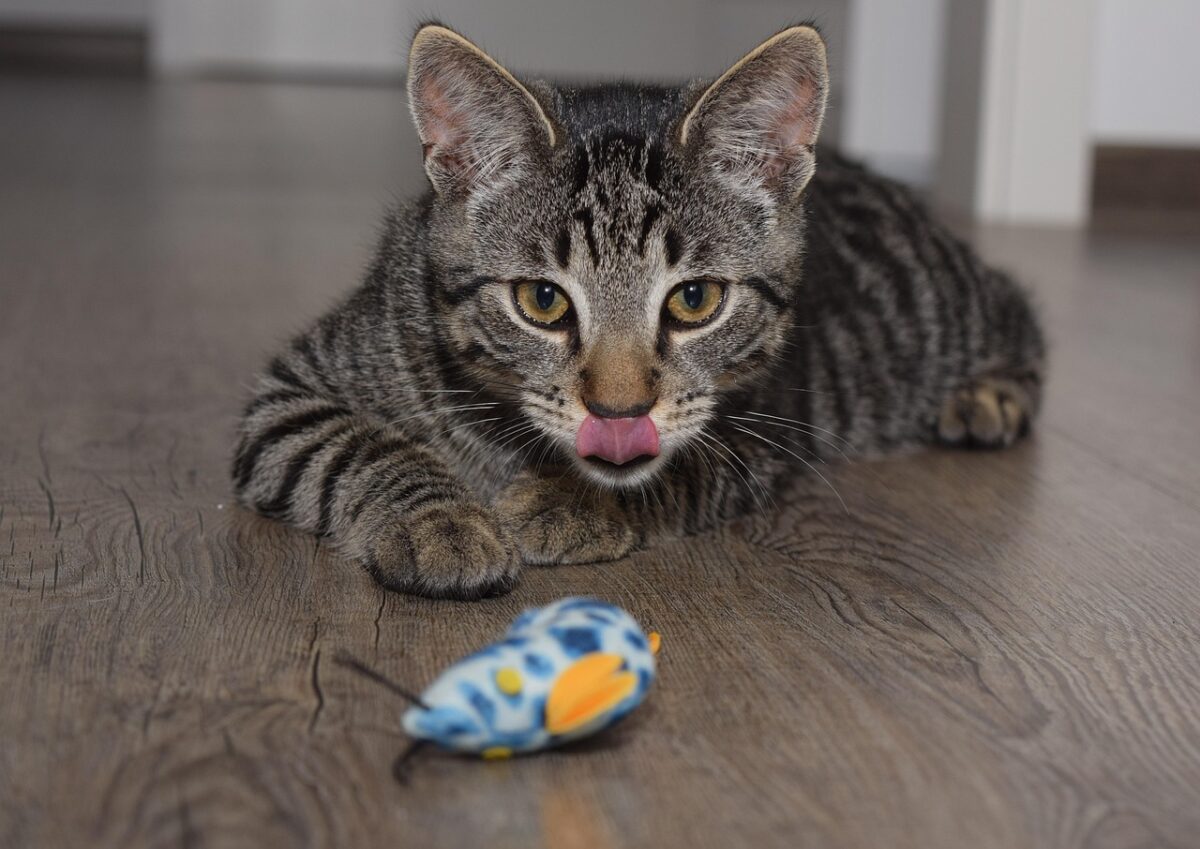
Your cat may spend most of the day asleep in a sunbeam, purring on your lap, or batting harmlessly at a toy mouse.
But outside, that same soft little companion becomes one of nature’s most efficient hunters.
That is the predation paradox: the animal we welcome into our homes as family is also built to stalk, chase, and kill. Not because cats are cruel. Not because they are poorly trained. Not because they are hungry.
Because they are cats.
And when millions of cats follow that instinct outdoors, the result is staggering: billions of birds killed every year in the United States alone.
This doesn’t mean cat owners should feel guilty for loving their pets. It means we need to be honest about the impact, and smarter about how we manage it.
This video shows a Maine Coon reacting to a bird, making the hunting instinct easy to see in real time. Watch for the focused stare, lowered body posture, and sudden bursts of movement that show how quickly a cat’s predatory drive can take over.
The Data: How Many Birds Do Cats Kill Each Year?
The answer is bigger and more complicated than most people expect.
The 2.4 Billion Estimate
The number most often cited is startling: about 2.4 billion birds killed by cats each year in the United States.
That figure comes from a 2013 study published in Nature Communications, which estimated that free-ranging domestic cats kill between 1.3 and 4.0 billion birds annually in the contiguous U.S. The midpoint, roughly 2.4 billion, is the number most conservation groups reference today.
What Studies Actually Show
This does not mean every house cat is killing birds every day.
The estimate includes both:
- owned cats that spend time outdoors
- unowned cats, including stray and feral cats
That distinction matters. Some pet cats rarely hunt. Others hunt often. Many never bring anything home at all.
But the ecological impact comes from scale. Even if one outdoor cat kills only a few birds a year, multiply that across millions of free-roaming cats, and the total becomes enormous.
The “Hidden Kill” Problem
One reason cat predation is easy to underestimate is that owners usually only see what their cat brings home.
But cats do not retrieve every animal they catch. Some prey is eaten, abandoned, hidden, or left outdoors. So a cat that drops one bird on the porch may have caught several others the owner never sees.
That “hidden kill” problem makes outdoor-cat hunting both difficult to measure and easy to dismiss.
Feral vs. Owned Cats
Feral and stray cats generally cause the largest share of bird mortality because they live outdoors full-time. They hunt for more hours, cover more ground, and often survive partly by catching wildlife.
But owned cats still matter.
An indoor-outdoor pet may be vaccinated, microchipped, loved, and well-fed… but once outside, it is still a predator. The issue is not whether the cat has a home. The issue is whether it has access to birds.
Geographic Impact Differences
Cat predation is not evenly distributed.
The risk is often higher in places where birds are already vulnerable, such as:
- islands
- nesting areas
- fragmented habitats
- suburban neighborhoods near green space
- areas with large feral cat colonies
In these environments, cat predation can add pressure to bird populations already dealing with habitat loss, window collisions, pesticides, and climate stress.
That is why the question is not just, “Does my cat kill birds?”
The better question is: What happens when millions of cats get the same opportunity?
The Secret Life of Your “Living Room Tiger”
It’s easy to look at your cat, curled up in a sunny window or chirping at a moth, and think there’s no way they’re a serious predator.
But the moment they step outside, that changes.
The same cat that naps on your couch becomes a quiet, efficient hunter, moving through backyards and shrubs largely unseen. And most of what they do out there never makes it back to your doorstep.
The “One-in-Four” Reality
Every cat owner knows the moment: a “gift” left on the rug, proudly delivered.
It’s tempting to see that as an occasional event.
But research using small cameras attached to cats, often called “KittyCams,” revealed something surprising:
Cats typically bring home only about 23–25% of what they catch.
In other words, for every bird you see, there are likely several you don’t. Some prey is eaten. Some are abandoned after being played with, and some never leave the spot where they were caught.
That means a cat that appears to hunt rarely may actually be far more active than it seems.
A National Impact Made of Local Moments
On its own, one cat catching a bird here or there may not seem like a big deal.
But multiply that behavior across millions of cats, and the impact adds up quickly.
Scientists estimate that cats kill billions of birds each year in the United States, making them one of the most significant human-linked threats to bird populations. And while feral cats account for a large share of that number, owned pets still contribute hundreds of millions of bird deaths annually.
This is where perception and reality diverge.
Your cat may feel like an exception. But at scale, small individual actions become a large collective impact.
Why This Matters for Your Cat’s Safety
The hidden hunting doesn’t just affect birds: it affects your cat, too.
When cats interact with wild birds, they’re also exposed to risks most owners never see.
- Parasites and bacteria: Birds can carry organisms like roundworms and harmful bacteria that can infect cats, and sometimes spread to humans.
- Injuries: Even small birds can scratch, peck, or transmit infections through minor wounds.
- Emerging diseases: In recent years, outbreaks of avian influenza (H5N1) have raised new concerns. Cats that catch or play with infected birds can be exposed to serious illness.
What looks like harmless “play” can carry real consequences. Understanding these numbers isn’t about guilt. It’s about perspective.
Your cat isn’t doing anything wrong; they’re doing exactly what they were designed to do. But they’re doing it in a world where ecosystems are already under pressure, and where those interactions can come with hidden risks.
When you reduce your cat’s exposure to birds, you’re not just protecting wildlife. You’re protecting your cat from injuries, disease, and a whole layer of unseen danger that comes with life outdoors.
Why Cats Hunt Birds, Even When Fed
At first glance, it might seem confusing. Why would a well-fed, pampered house cat still feel the need to hunt and kill birds?
The answer lies deep in their DNA. Domestic cats are obligate carnivores and natural-born hunters, with instincts that trace back thousands of years to their wild ancestors. Even the fluffiest indoor cat shares behavioral wiring with wild predators like lions and leopards.
Cats do not need a reason to hunt birds. They only need the opportunity.
This is what your cat is built to do. The moment something moves, instinct takes over.
Instinct, Not Morality
Cats do not kill birds because they are cruel, bored, or poorly cared for.
They do it because they are predators.
As obligate carnivores, their bodies are built for hunting, with sharp claws, forward-facing eyes, silent movement, and fast reflexes. Even the most pampered house cat shares this wiring with wild predators.
A full food bowl may satisfy hunger. It does not turn off instinct.
Why Birds Trigger the Hunting Response
To a cat, a bird is almost impossible to ignore.
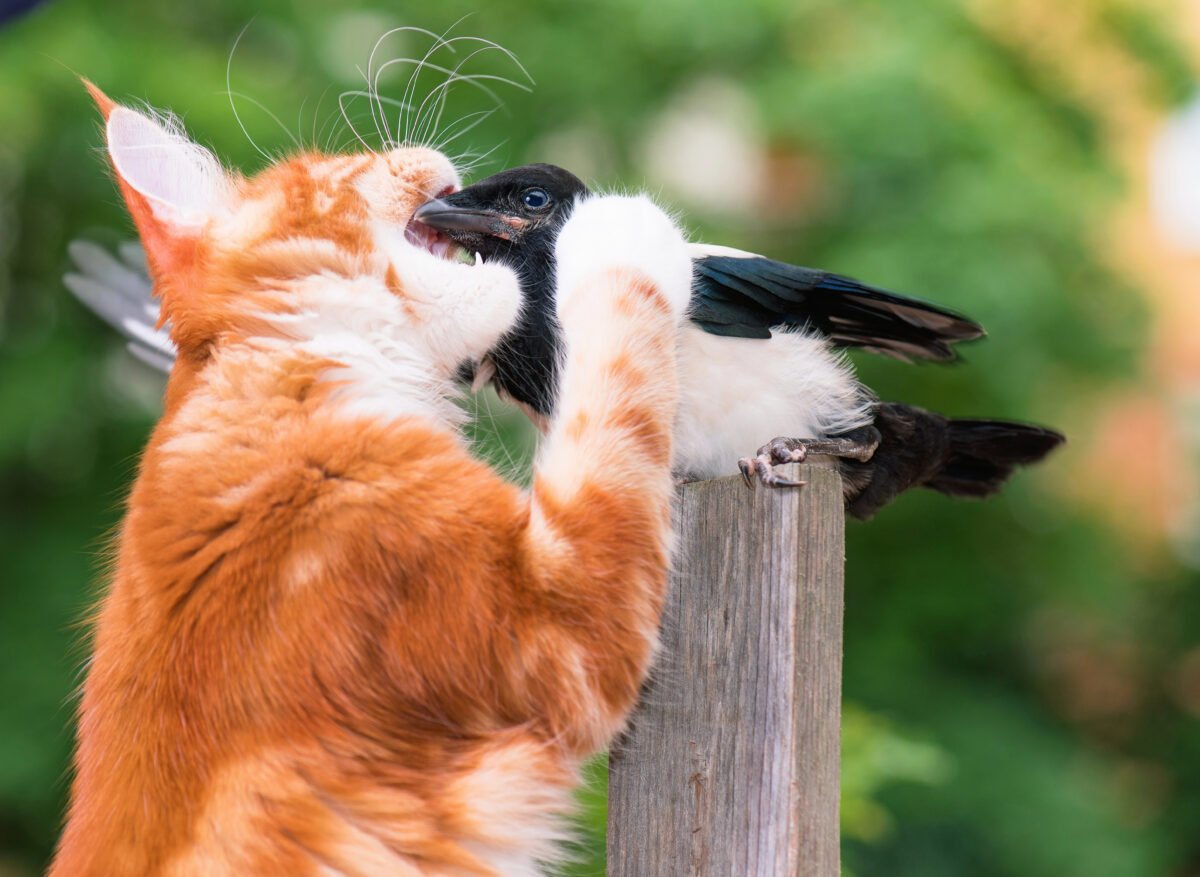
Fluttering wings, quick hops, and sudden bursts of movement create the exact kind of unpredictable motion cats are wired to detect. That movement alone is enough to activate their predatory focus.
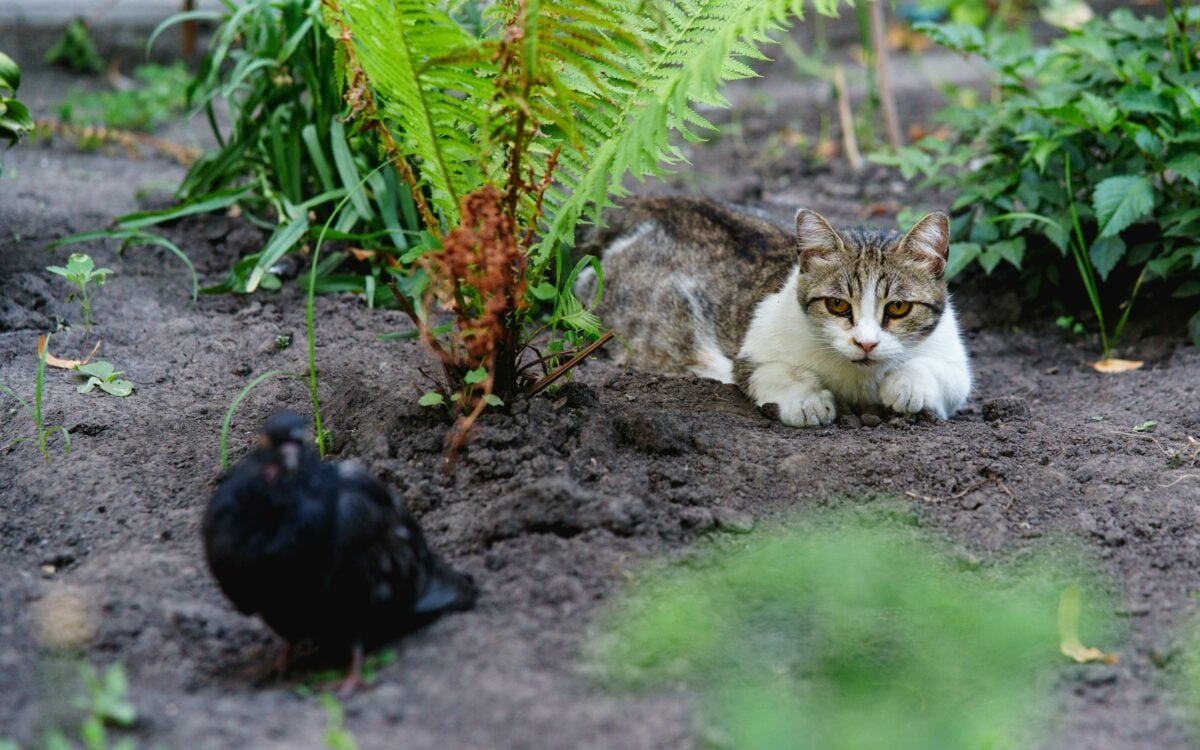
You can see it instantly: the freeze, the crouch, the slow, deliberate stalking.
The Predatory Sequence
Once triggered, cats follow a hardwired sequence:
stalk → crouch → chase → pounce → capture → kill
They are not making a conscious choice in the moment. They are following a built-in script.
This is the same behavior you see during play. Feather wands, toy mice, and moving strings all mimic prey.
Play is not separate from hunting. It is practice.
Why Birds Are Especially Vulnerable
Birds are not equally at risk all the time.
Cats are most likely to catch birds when they are:
- feeding on the ground
- distracted at feeders
- nesting low in shrubs
- injured or stunned
- newly fledged and still learning to fly
Fledglings are especially vulnerable because they often spend time on the ground before they can fly well. To a cat, a young bird fluttering in the grass is an easy target.
Why Feeding Does Not Stop It
One of the most common misconceptions is that a well-fed cat will not hunt.
But hunger is not the main driver.
Cats often hunt birds even when they are not hungry because the behavior itself is rewarding. Movement triggers the chase, and once that sequence starts, it is hard to interrupt.
Research published in Current Biology found that improving diet and increasing daily play reduced the amount of wildlife cats brought home, suggesting hunting is driven by stimulation and reward, not just survival.
Feeding your cat reduces hunger. It does not remove the instinct to hunt.
Understanding this changes the solution. You cannot train instinct out of a cat. But you can control the environment where that instinct plays out.
Bridging the Gap: Practical Solutions for You and Your Cat
It is one thing to understand the data. It is another to figure out what to do when your cat is crying at the back door.
Most cat owners want the same thing: a happy, enriched pet and a yard full of birdsong. The good news is, you do not have to choose one or the other.
Here are practical ways to protect birds while still giving your cat a fulfilling life.
1. Catios: Outdoor Access Without the Risk
If your cat enjoys the outdoors, a catio is one of the most effective solutions.
A catio is a secure, enclosed outdoor space that allows your cat to experience fresh air, sunlight, and stimulation without direct contact with wildlife.
- Window box enclosures for small spaces
- Patio or balcony enclosures
- Full backyard structures with tunnels and climbing areas
This approach gives your cat the sights and smells of the outdoors while completely eliminating hunting.
The video below shows an easy-to-follow process to build your cats an amazing outdoor catio:
2. Bird-Safe Collars and Devices
If your cat still spends time outdoors, certain tools can reduce hunting success.
- Birdsbesafe collars: These brightly colored fabric covers make cats more visible to birds. Because birds detect color well, this gives them extra time to escape. Studies have shown significant reductions in bird captures.
- Cat bibs: Lightweight attachments that interfere with a cat’s ability to execute a precise pounce. They do not stop movement, but they reduce hunting success.
These tools are not perfect, but they can meaningfully reduce harm when full containment is not possible.
3. Replace the Hunt With Play
If your cat spends less time outdoors, you need to replace the stimulation they would normally get from hunting.
The most effective approach is structured play that mimics real hunting behavior.
Use wand toys, feather toys, or fast-moving objects that simulate prey. Let your cat stalk, chase, and pounce.
Then follow a simple cycle:
play → eat → groom → sleep
This sequence mirrors natural hunting behavior and helps satisfy your cat’s instincts indoors.
Adding vertical space, such as cat trees or wall shelves, also gives indoor cats a sense of territory and reduces stress. You can also install a window perch that allows them to see birds through the safety of the window glass.

4. Smarter Bird Feeding
If you feed birds, your yard setup can either reduce or increase risk.
- Place feeders at least 10 feet away from shrubs or hiding spots
- Keep feeders elevated and out of jumping range
- Avoid creating dense ambush zones near feeding areas
Small adjustments can make a big difference in bird survival.
A Quick Checklist for Cat Owners
- Keep cats indoors during dawn and dusk when birds are most active
- Use breakaway collars for safety
- Ensure your cat is microchipped and has identification
- Provide daily interactive play to reduce hunting behavior
You do not have to eliminate your cat’s instincts. You just need to manage where and how those instincts are expressed.
When you reduce your cat’s access to birds, you are not only protecting wildlife. You are also reducing your cat’s risk of injury, disease, and other outdoor dangers.
Small changes at the individual level can add up to a meaningful impact.
The Reality of Feral Cats
A large portion of bird predation comes from stray and feral cats. These cats live outdoors full-time and hunt to survive. Managing these populations typically involves community efforts such as Trap-Neuter-Return (TNR) programs.
But as a pet owner, your greatest impact is much closer to home.
By managing your own cat’s access to wildlife, you can significantly reduce the pressure on local bird populations. If you feed feral cats, you may want to take a closer look at the laws and responsibilities around it in your area. And keep in mind that feeding them brings more cats to the area, which can impact the number of birds killed.

5 Quick Tips for Bird-Friendly Cat Owners
You do not have to overhaul your cat’s entire life overnight. A few small changes can make your home and yard safer for birds while still keeping your cat happy.
- Keep cats indoors at dawn and dusk. Birds are often most active and vulnerable during low-light hours.
- Upgrade the collar. Use a bright, high-visibility collar cover instead of relying only on a bell.
- Add daily play. A 10 to 15-minute wand toy session helps satisfy your cat’s predatory drive indoors.
- Move bird feeders away from cover. Keep feeders at least 10 to 12 feet from bushes, tall grass, fences, or furniture where cats can hide.
- Know what to do in an emergency. If your cat catches a bird, separate the cat, place the bird in a dark box, and contact a wildlife rehabilitator.
What If Your Cat Is Already 100% Indoors?
If your cat lives strictly indoors, you are already doing one of the most effective things to protect birds.
That said, indoor cats can still encounter birds if one flies into your home or if your cat slips outside unexpectedly. Knowing how to handle those situations and providing daily play helps keep both your cat and local wildlife safe.
Can You Transition an Outdoor Cat to Indoor Life?
It is possible, but it works best as a gradual process.
Cats that are used to going outside often resist sudden change. Instead of cutting off access completely, start by reducing outdoor time and replacing it with indoor enrichment.
Short, structured play sessions, climbing spaces, window perches, and consistent routines can help your cat adjust over time.
Many cats that once insisted on going outside can learn to enjoy indoor life, especially when their need to hunt, climb, and explore is met in other ways.
The key is not restriction. It is replacement.
For many cat owners, this shift can feel unrealistic at first. But small changes can make a big difference.
A Personal Note: What I Did With Roxie
I understand this issue firsthand because my own cat, Roxie, has been an indoor-outdoor cat.
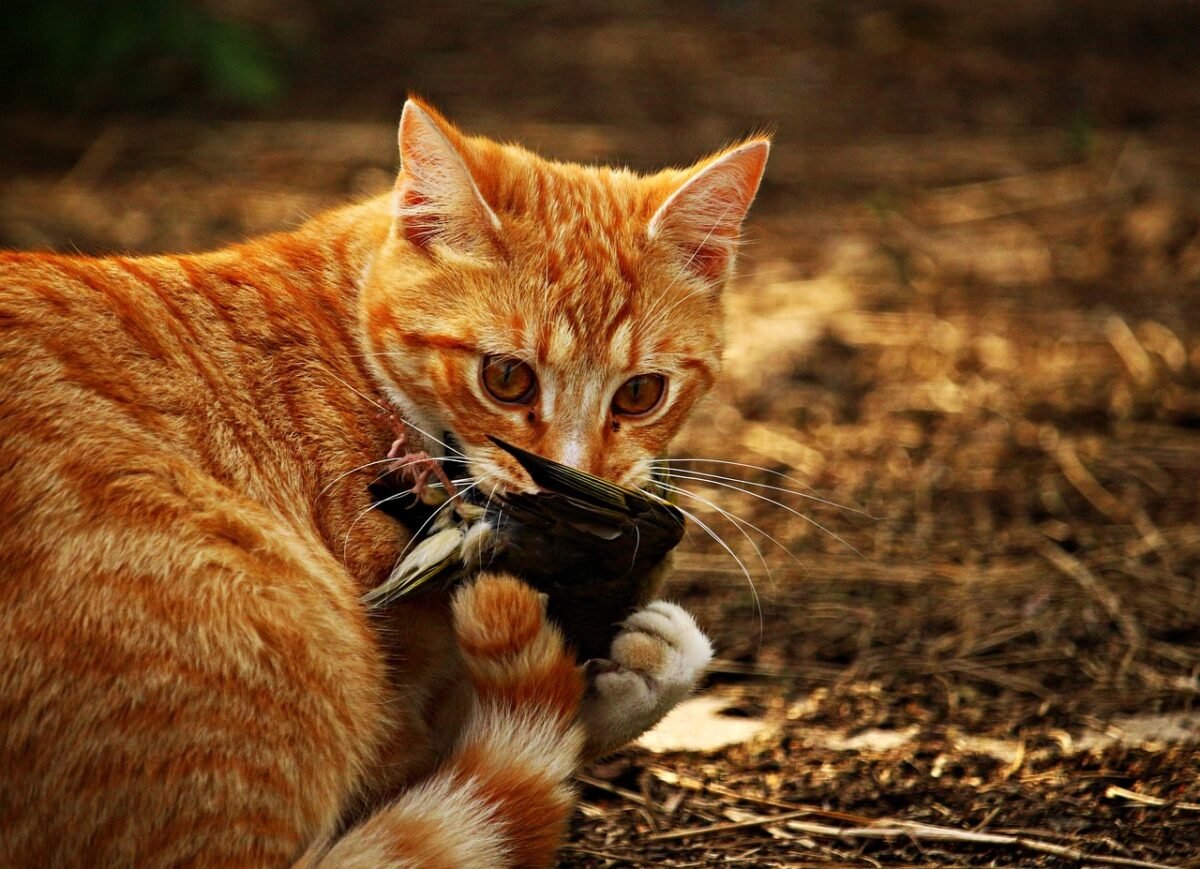
For a while, she brought home plenty of “gifts,” including mice and birds. At first, it seemed like normal cat behavior. But eventually, it became clear that her hunting was becoming a real problem, especially during times when birds were most active.
So we started making changes. We kept Roxie indoors during peak bird activity, especially early morning and evening, and gave her more indoor alternatives to satisfy that hunting drive.
That meant more play, more stimulation, and more ways for her to burn off energy without taking it out on local wildlife.
It was not about punishing her for being a cat. It was about recognizing the impact and finding a better balance for everyone involved: Roxie, the birds, and our peace of mind.
Crisis Management: What to Do When Your Cat Brings in a Live Bird
If your cat brings in a bird, especially one that is still alive, act quickly but stay calm. The goal is to reduce stress for the bird and get it professional help as soon as possible.
1. Secure the Cat First
Before you approach the bird, remove the cat from the situation.
Place your cat in a separate room and close the door. If the cat feels like you are taking away its prey, it may bite down harder or try to escape with the bird. Separating them is the fastest way to reduce stress and prevent further injury.
2. Gently Contain the Bird
Birds are extremely sensitive to stress and can be injured easily during handling.
Use a light towel or a t-shirt to gently cover the bird. This helps calm it by blocking visual stimuli and prevents it from flapping and injuring itself.
Carefully place the bird into a small cardboard box with air holes and a soft cloth at the bottom.
Keep the box in a warm, dark, and quiet place. Avoid checking on the bird repeatedly, and do not attempt to feed or give it water.
3. Understand the Saliva Risk
This step is critical.
Cats carry bacteria in their mouths, including Pasteurella, that are highly dangerous to birds. Even a tiny scratch or unseen puncture can lead to a fatal infection within 24 to 48 hours.
If a cat has had any contact with a bird, that bird needs professional care.
Even if the bird appears alert or flies away, infection is still a serious risk.
4. Contact a Wildlife Professional
Wild birds require specialized care that is difficult to provide at home.
Use Animal Help Now to locate a licensed wildlife rehabilitator near you. Some veterinary clinics may accept injured wildlife, but always call ahead to confirm.
5. Check Your Cat, Too
Once the bird is contained and you have contacted a wildlife rehabilitator, take a moment to check your cat for injuries.
Look for scratches around the face, eyes, paws, and mouth. Birds can peck, scratch, or expose cats to parasites and bacteria. If your cat seems lethargic, has swelling, is bleeding, or may have eaten part of the bird, call your veterinarian.
6. Clean and Disinfect
After the bird has been safely transferred, clean the area thoroughly.
Wash your hands and disinfect any surfaces the bird came into contact with. Wild birds can carry mites, parasites, and bacteria such as Salmonella.
Moments like this can be stressful, but they are also an opportunity to act quickly and responsibly. Getting the bird to professional care gives it the best possible chance of survival and helps prevent unnecessary suffering.
FAQs and Quick Tips for Bird-Friendly Cat Owners
By this point, the pattern is clear: cats hunt because of instinct, birds are vulnerable when given the opportunity, and small owner choices can make a real difference.
Here are a few quick answers to the most common questions cat owners have about keeping both cats and birds safer. If you don’t see yours, drop it in the comments!
Do bells on collars actually work?
Usually, not very well. Bells may seem like an easy fix, but many cats learn to move quietly enough that the bell does not give birds much warning.
Visual deterrents, such as bright Birdsbesafe-style collar covers, are generally more effective because they make the cat easier for birds to see before the pounce.
What should I do if my cat brings home a dead bird?
Focus on hygiene first.
Use gloves or a plastic bag to pick up the bird, then dispose of it in a sealed outdoor trash bin. Wash your hands thoroughly and disinfect the area where the bird was found.
Do not let your cat eat the bird. Wild birds can carry parasites, bacteria, or trace exposure to pesticides and rodenticides.
My cat is strictly indoors. Why does this matter to me?
Even indoor cats can become accidental hunters.
A bird may fly into the house, or your cat may slip outside unexpectedly. Understanding what to do in those moments helps protect both your cat and local wildlife.
It also helps you provide better indoor enrichment, since play, climbing, and puzzle feeders give cats a safer outlet for their hunting instincts.
Can I still have a bird feeder if I have a cat?
You sure can, but placement matters.
Keep feeders at least 10 to 12 feet away from bushes, tall grass, porch furniture, fences, or anything else a cat could use as ambush cover.
If you cannot place a feeder in a safe, open area, it may be better to skip the feeder rather than accidentally lure birds into danger.
Some cat owners face a slightly different challenge: sharing their home with both a cat and a pet bird.
Can Birds Live With Cats?
Pet birds and cats can live in the same home, but they should never have direct, unsupervised access to each other.
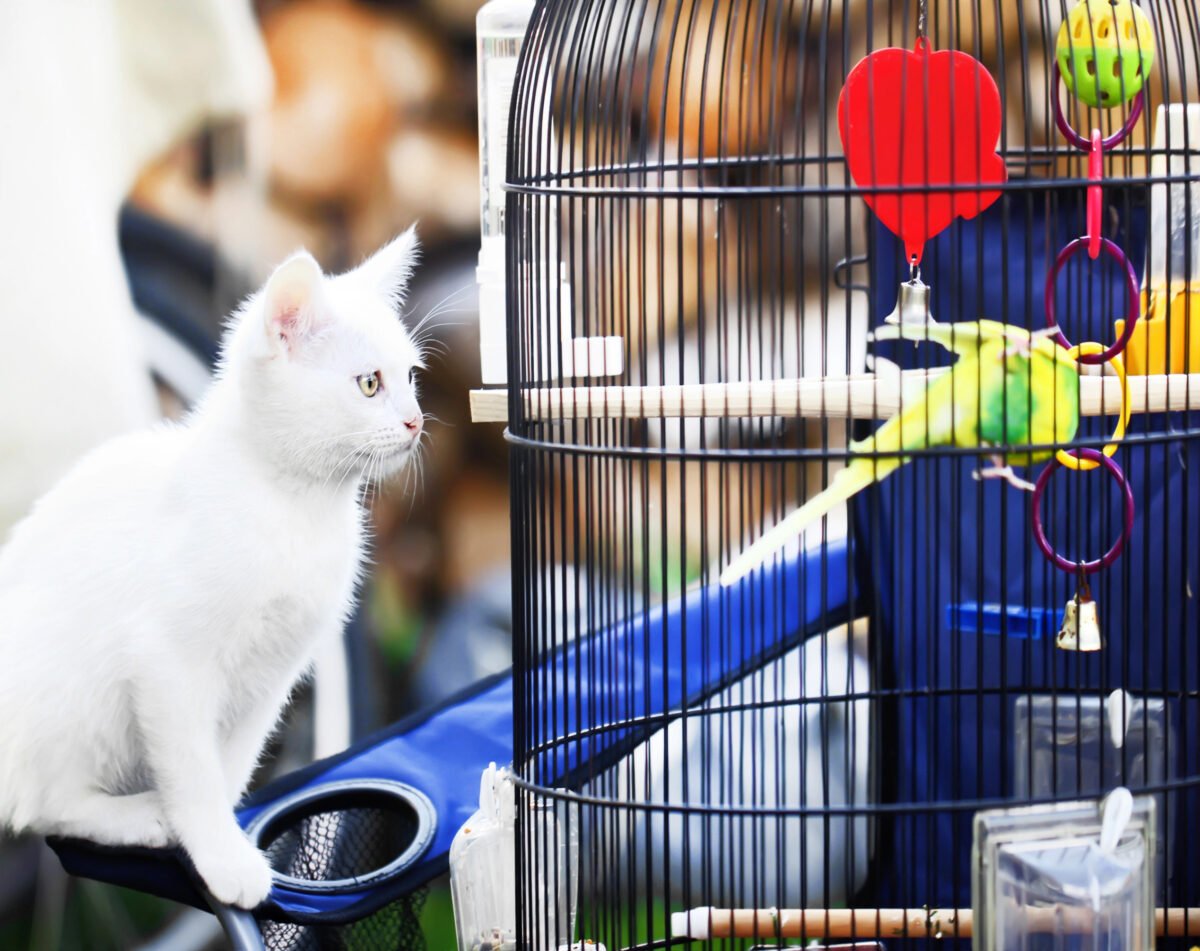
Even a gentle cat can injure a bird through instinctive play, a sudden swat, or a bite. For birds, even minor contact with a cat’s teeth or claws can become dangerous because of bacteria in cat saliva.
If you have both cats and pet birds, keep the birds’ cage in a secure room that your cat cannot access when you are not present. Use a sturdy cage, lock the doors, and avoid letting your bird perch or fly freely while your cat is nearby.
The safest rule is simple: cats and birds can share a home, but they should not share open space.
It is also worth noting that birds can injure cats, too. Larger parrots and other pet birds may bite, scratch, or strike with enough force to hurt a cat’s face, eyes, or paws. Even small birds can cause panic or defensive reactions that put both animals at risk.
For both animals’ safety, interactions should be avoided unless closely supervised and controlled.
Understanding Your Cat’s Wild Side
Bird hunting is only one example of how your cat’s instincts show up in everyday life. The same drive that makes cats stalk birds can also explain why they chase insects, obsess over the outdoors, prowl at night, or react strongly to other animals.
If your cat is constantly trying to get outside, start with our guide on why indoor cats try to escape. If their behavior feels frustrating indoors, you may also like our breakdown of why cats act annoying and what they may really need.
Cats also interact with plenty of other creatures besides birds. Learn what happens when cats encounter snakes, why they may chase and eat flies, what to do if your cat gets stung by a bee, and whether cat fights can turn deadly.
And if your cat seems most active when you are trying to sleep, our guide to whether cats are nocturnal can help explain those late-night zoomies.
The more you understand your cat’s instincts, the easier it becomes to keep them safe, enriched, and out of trouble.
Love Your Cat, Protect Your Birds
Every backyard bird saved matters, and small choices from cat owners can add up quickly.
Have you found a way to protect the birds in your yard from your cat? Share what worked in the comments so other bird-loving cat owners can try it too.