When you purchase through links on our site, we may earn a commission at no extra cost to you. Learn more.
Some Maine Coon colors look rare. Others are truly rare, but most people don’t realize it.
Table of Contents
A cat that looks gray might actually be silver. A “brown” coat might be golden. And that “solid” orange cat? It probably isn’t solid at all.
The truth is, some of the rarest Maine Coon colors are the easiest to misidentify. And once you know what to look for, you’ll start seeing them completely differently.
Start Here: You’ve Seen These Colors… But Not Like This
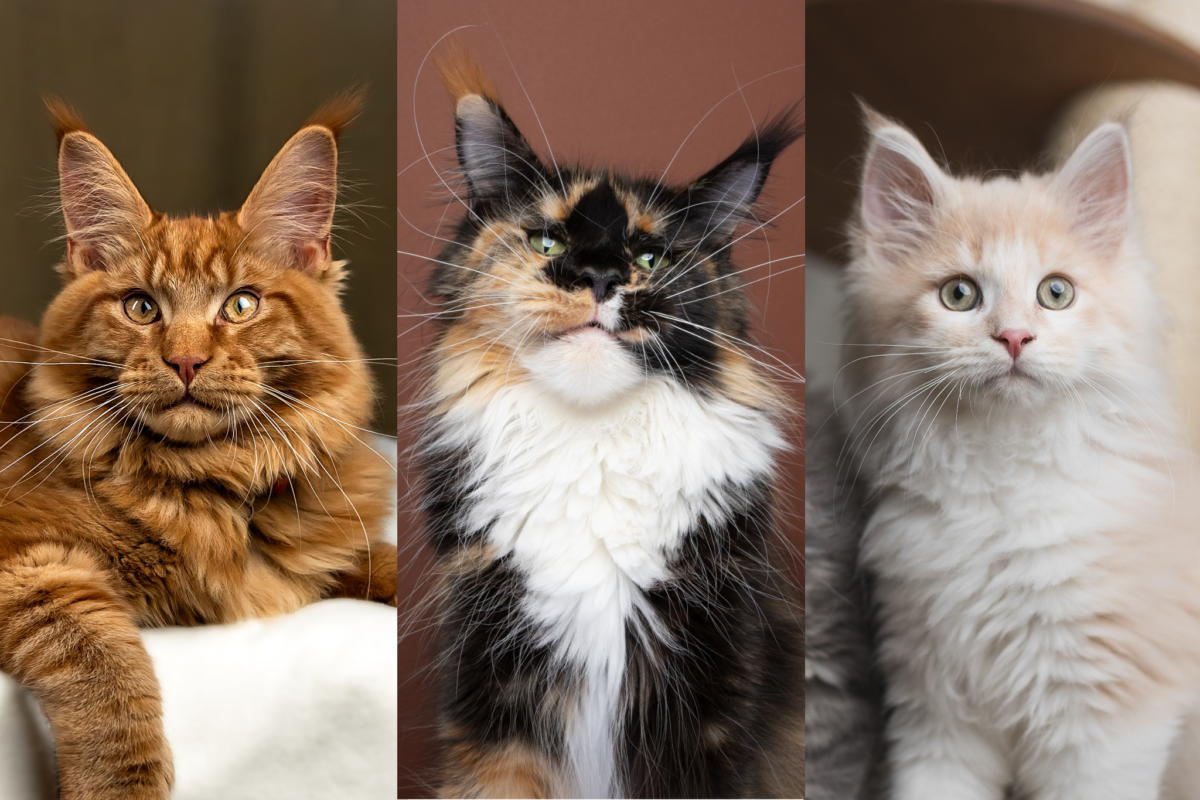
Some of the rarest Maine Coon colors are hiding in plain sight.
Want our human-written content to rank above AI-generated garbage? Help us out by clicking this button!
You’ve probably seen them labeled as gray, brown, or just “orange.” But those labels miss what’s actually happening in the coat.
Each hair on a Maine Coon isn’t just one color. It has a base, a tip, and sometimes a pattern layered on top. That’s why silver can look gray, why gold can look brown, and why some “solid” cats aren’t actually solid at all.
Rare doesn’t mean random. It comes down to genetics, breeding probability, and how strictly registries define coat types. That’s why two cats that look similar at a glance can fall into completely different categories.
In this guide, we’re breaking down the rarest Maine Coon colors, why they’re hard to find, and how to spot the differences most people miss.
What Actually Makes A Maine Coon Color “Rare”?
Not all “rare” colors are rare for the same reason. In reality, rarity comes down to three things:
- Genetics: How likely the color is to occur naturally
- Breeding: How difficult it is to produce consistently and whether breeders actively select for it
- Registry definitions: How precisely the color is classified
Some colors are genetically complex. Others are simply not in demand, so they are bred less often.
The 7 Rarest Maine Coon Colors
Not all rare colors are rare for the same reason. Some are genetically difficult to produce. Some are rarely bred due to owner interest.
Here are the most consistently uncommon Maine Coon colors, starting with the ones that are hardest to find in practice.
1. Golden Maine Coons: The Color Breeders Can’t Fully Control
Golden Maine Coons are one of the most sought-after and one of the hardest to produce consistently.
They’re not just warm-toned tabbies. A true golden Maine Coon is the result of a very specific and uncommon combination of genes that change how color appears across each strand of fur.
Golden is not just a color. It is an effect.
Why It’s Rare
Golden Maine Coons are produced through a complex interaction of genes, not a single color gene. They typically carry the melanin inhibitor gene, which is also responsible for silver and smoke coats, along with a group of modifiers known as wide-band genes. These genes control how much pigment is deposited along each hair shaft.
This combination creates a warm cream-to-apricot base with darker tipping, rather than the cool white undercoat seen in silver cats.
Because this genetic combination is difficult to predict, even experienced breeders cannot reliably produce golden kittens. That uncertainty is exactly what makes this color so rare.
How To Spot It
- Warm, glowing undercoat with golden or honey tones
- Overall “glowing” or metallic appearance
- Less contrast than standard tabby patterns
- Often paired with green or gold eyes
Not All Registries Agree
Golden Maine Coons are recognized and actively bred in some organizations, including Fédération Internationale Féline (FIFe), where they appear under categories like:
- Black or blue golden
- Red, cream, or tortie golden
- Golden with white
However, they are not formally recognized in all registries, including Cat Fanciers’ Association (CFA), which is why information about them can feel inconsistent depending on the source.
2. Chinchilla & Shaded Maine Coons: Precision-Level Coat Colors
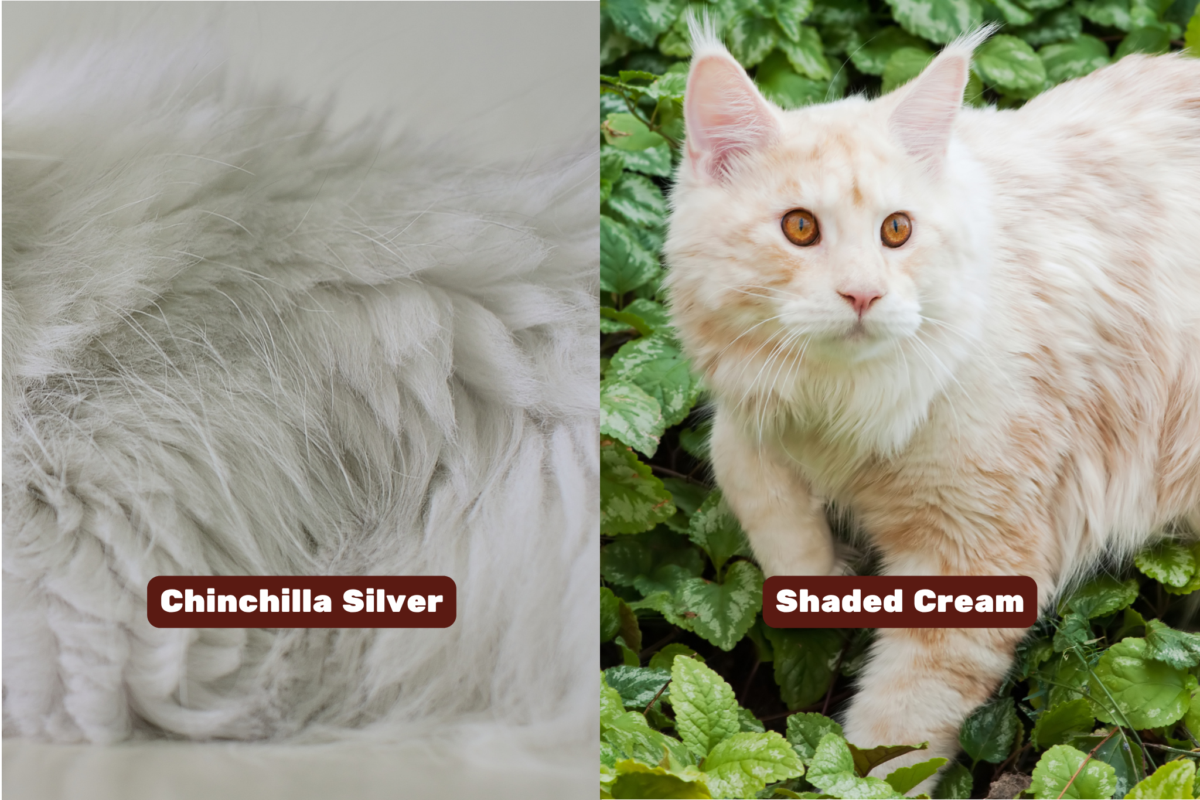
Chinchilla and shaded Maine Coons are some of the most technically refined coat types in the breed. What makes them rare is not the color itself. It is how little of each individual hair is actually pigmented.
This is where Maine Coon coat genetics becomes extremely precise.
Why It’s Rare
Both chinchilla and shaded coats require:
- The inhibitor (silver) gene
- Wideband modifiers that reduce pigment along the hair shaft
- Precise control over how much of each hair is actually colored
Instead of full pigmentation, the color is pushed toward the tip of the hair. Small differences in that distribution create completely different visual outcomes.
Why Some Shaded Cats Are Rarer Than Others
Not all shaded Maine Coons are equally rare. There is a spectrum within these coat types based on how clean and controlled the pigment distribution is.
At one end, you’ll find shaded cats that still show faint tabby influence, such as soft striping on the legs, tail, or face. These are more common and often easier to produce.
At the other end are highly refined shaded and chinchilla coats, where:
- Pigment is evenly distributed
- Tabby markings are nearly or completely absent
- The coat appears smooth, uniform, and “airbrushed”
These are significantly harder to achieve.
Because the tabby pattern is part of the underlying genetics in most Maine Coons, fully minimizing it requires very precise breeding. That’s why truly clean shaded silver and chinchilla silver cats are not just rare — they’re difficult to consistently produce.
Not Just One Color
You’ll see these patterns applied to multiple base colors, including:
- Chinchilla silver / shaded silver (most recognizable)
- Blue silver (a softer, cooler-toned version)
- Shell cameo (red chinchilla) (warm, peachy glow)
- Shaded cameo (red shaded)
- Cream chinchilla / shaded cream (very soft, pastel look)
- Tortoiseshell and blue-cream variants (multi-tonal and especially uncommon)
While the names vary, they all refer to the same rare tipping pattern applied to different base colors.
How To Spot It
Chinchilla (Shell):
- Only the very tip of each hair is pigmented (about 1/8)
- Overall appearance is very pale, almost white
- Coat has a soft, sparkling or “frosted” effect
Shaded:
- More of the hair shaft is pigmented (about 1/4)
- Appearance is noticeably darker than chinchilla
- Shows a gentle gradient from dark (topline) to light (underside)
Both share:
- White undercoat
- Dark outlining around the eyes, lips, and nose
- Nose leather typically brick red
- Paw pads typically black
The easiest way to tell them apart is overall brightness. Chinchilla appears almost white from a distance. Shaded carries more visible depth.
Watch: Two shaded silver parents can produce chinchilla silver kittens, where pigment is reduced to just the tips of each hair.
A Quick Note On Silver (Why It Shows Up Here)
Silver isn’t a rare color on its own. It comes from the inhibitor gene, which removes pigment at the base of each hair and creates a pale, white undercoat.
Because of this, “silver” often appears in many coat names, from common silver tabbies to more specialized variations.
But when silver is combined with modifiers that control how far pigment extends along each hair, the result changes dramatically. That’s where chinchilla and shaded coats come in.
3. Smoke Maine Coons: The Color You Don’t Fully See Until The Coat Shifts
At first glance, a smoke Maine Coon can look like a solid-colored cat. Black. Blue. Red. Nothing unusual.
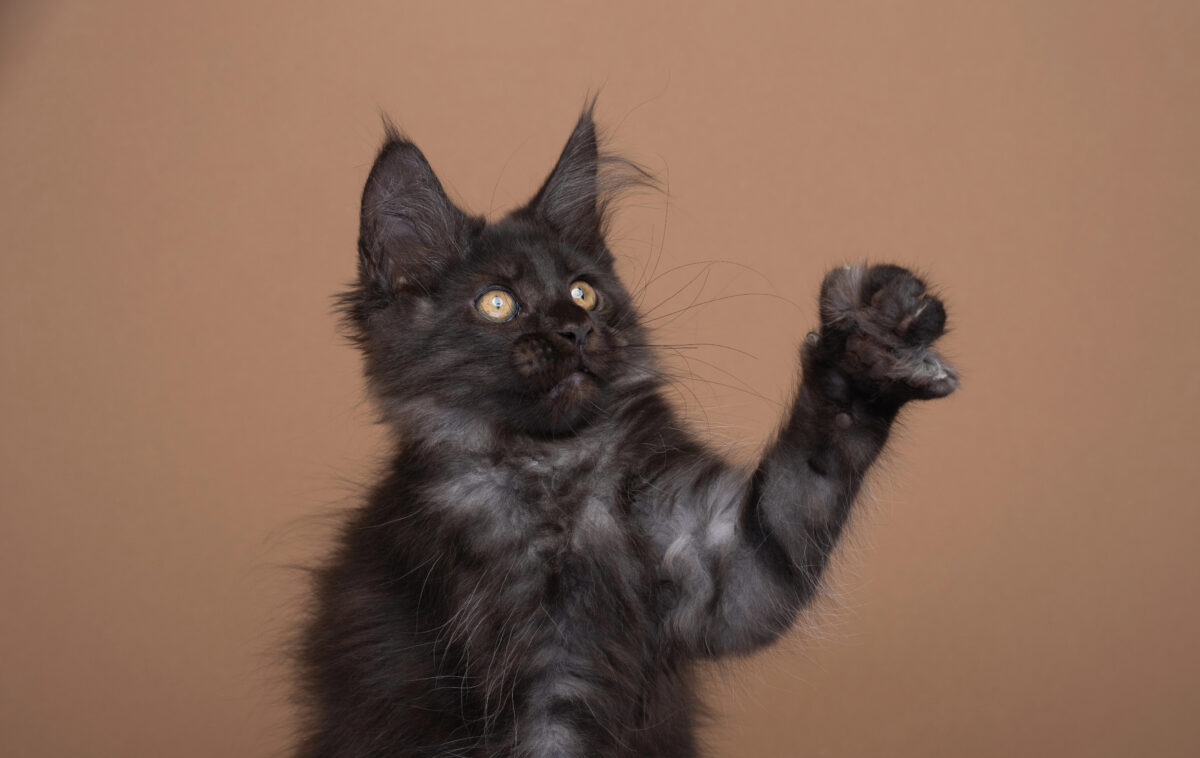
Then they move. And suddenly, the entire coat shifts, revealing a hidden white underlayer that wasn’t visible before.
That subtle reveal is what makes smoke one of the most striking and misunderstood coat types in the breed.
Why It’s Rare
To produce a true smoke coat, breeders need:
- The inhibitor gene
- A solid (non-tabby) base color
- The right balance so the coat doesn’t shift into a shaded or silver pattern
That combination is more difficult to achieve consistently, making smoke coats less common than standard solids or tabbies.
Not Just One Color
Smoke is a pattern effect applied to different base colors, including:
- Black smoke (most dramatic contrast)
- Blue smoke (softer, cooler gray tones)
- Cameo smoke (red smoke) (warm, coppery glow)
- Cream smoke (light, subtle contrast)
- Tortie smoke (multi-tonal with patches of red and black)
All of them share the same defining feature: a white undercoat beneath darker surface color.
How To Spot It
- Cat may appear mostly solid at first glance
- White base becomes visible when fur is parted
- Coat appears lighter or more dimensional in motion
- Often shows a lighter ruff, chest, or ear tufts
You may also notice that the face appears darker than the body, while the neck and chest look lighter. This is normal and comes down to how the coat grows in different areas.
What Makes It Different From Chinchilla Or Shaded
Unlike chinchilla or shaded coats, where the light base is part of the overall appearance, smoke coats keep that contrast mostly beneath the surface.
- Chinchilla/Shaded: light base is always visible
- Smoke: light base is partially hidden and revealed through movement or parting
That’s why smoke often surprises people. It doesn’t announce itself right away.
4. Solid White Maine Coons: The Coat That Hides Everything
A pure white Maine Coon has an almost unreal appearance. It is clean, bright, and immediately eye-catching.
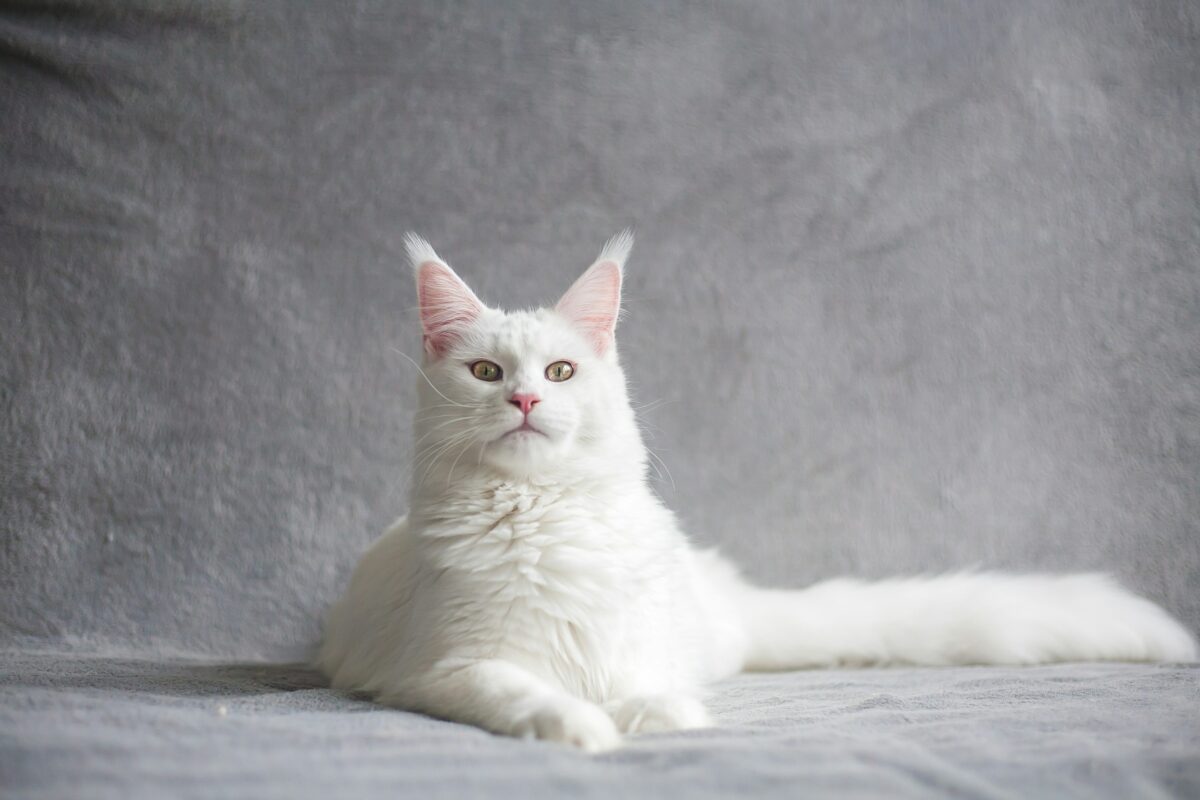
But what makes it rare is not just how it looks. It is how it works genetically.
Why It’s Rare
White Maine Coons carry a dominant masking gene that hides all underlying color, meaning the cat could genetically be black, tabby, tortoiseshell, or even calico.
How To Spot It
- Fully white coat with no visible pattern
- Pink nose leather and paw pads
- Eyes: green, gold, blue, or heterochromia (two different eye colors)
More Than Just Color
The gene responsible for white coats is also associated with hearing differences, particularly in cats with blue eyes. Not all white Maine Coons are deaf, but the link means responsible breeders have to take extra care when working with this color.
That added complexity is part of what makes solid white less common than it appears.
5. Solid Black Maine Coons: Why “Just Black” Isn’t Actually Simple
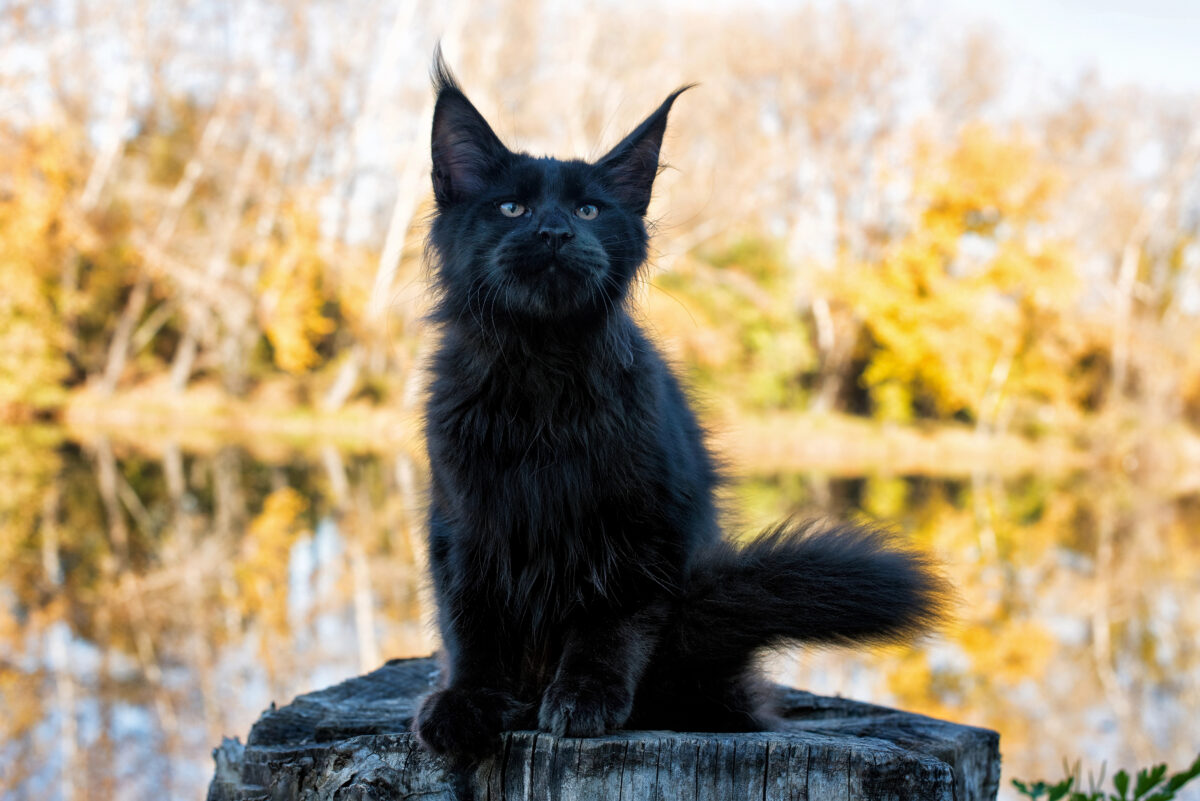
Black cats are everywhere, so how can they be rare? Because a true solid black Maine Coon isn’t just black. It’s uniform.
Why It’s Rare
A proper solid black Maine Coon should be dense, coal black from root to tip, with no visible pattern, fading, or underlying variation. That level of consistency is harder to achieve than it looks.
Solid black coats require the right genetic combination to suppress tabby patterning entirely. If any pattern influence shows through, even subtly, the coat won’t appear truly solid.
Even when a cat is genetically black, maintaining that deep, even color is not guaranteed. Many black Maine Coons show:
- A rust or brown tinge, especially in sunlight
- Faint “ghost” tabby striping
- A hidden smoke undercoat that becomes visible with movement or parting
Because of this, a true jet-black Maine Coon with no visible variation is less common than people assume.
How To Spot It
- Deep black coat from root to tip
- No brown or rust tones, even in bright light
- No striping or pattern when viewed closely
- Black nose leather
- Paw pads that are black or brown
6. Solid Red Maine Coons: The Color That Refuses To Be Solid
Most people call them orange Maine Coons. In breed standards, they’re classified as red.
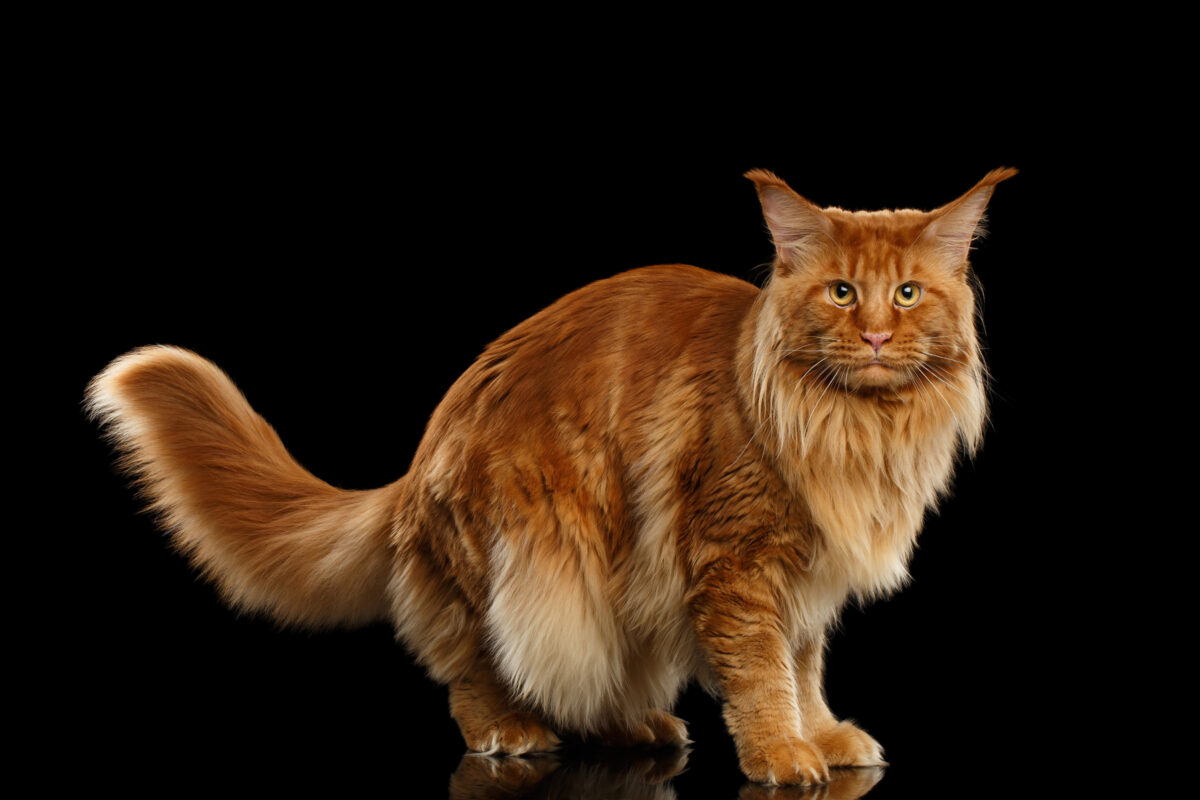
And while red cats are everywhere, a true solid red Maine Coon is much harder to find.
Why It’s Rare
Red coloration in cats is controlled by a sex-linked gene, which is why male cats are more commonly orange than females.
But the bigger challenge is this: Red pigment does not fully suppress pattern.
Even when a Maine Coon is genetically “solid,” the coat almost always shows faint striping, known as ghost markings. These markings are most visible on the face, legs, and tail.
Because of this, achieving a visually uniform red coat with minimal striping is much more difficult than it seems.
How To Spot It
- More uniform red tone across the body
- Subtle, low-contrast striping rather than bold tabby pattern
- Ghost markings most visible on the face and legs
- No white chin or pale muzzle
- Brick red nose leather and paw pads
The key difference is not the presence of pattern, but how visible it is
7. Calico Maine Coons: Rare Because of Biology, Not Appearance
Calico Maine Coon are instantly recognizable. The mix of white, black, and red creates a patchwork coat that looks completely unique from one cat to the next.
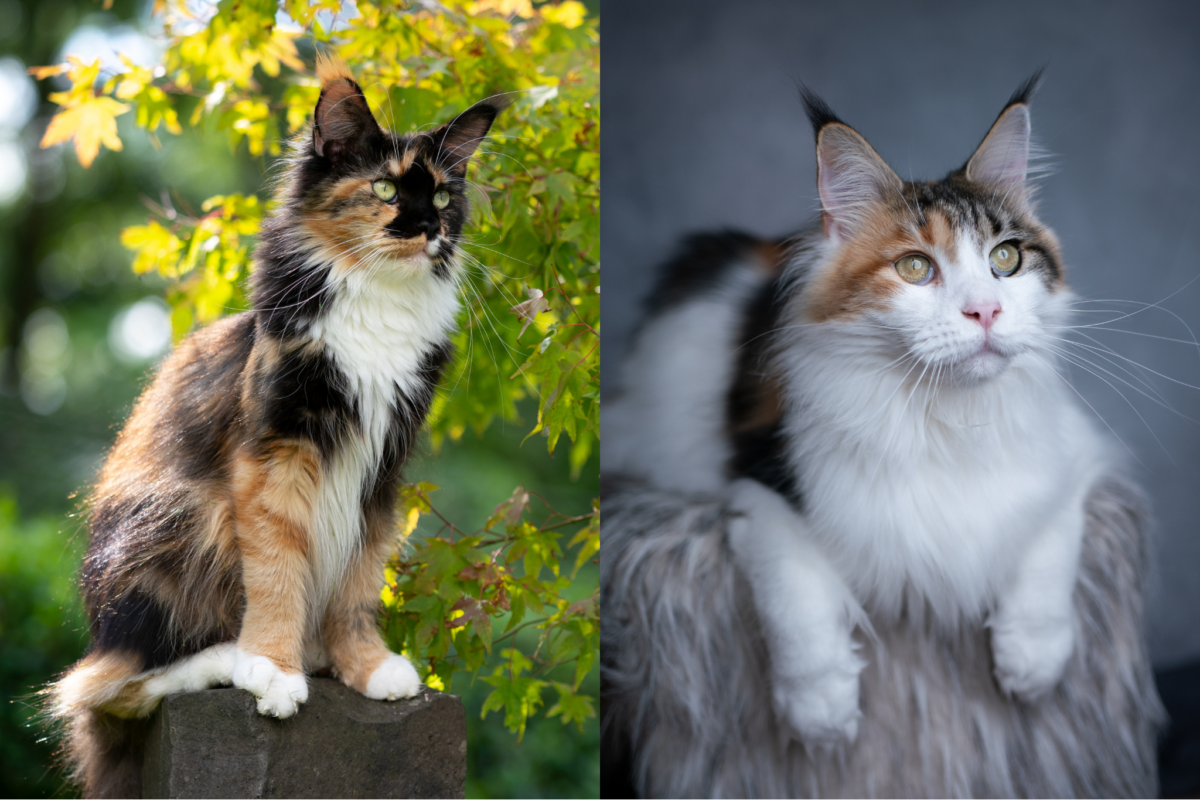
But what makes calico rare is not how it looks. It is how it is formed.
Why It’s Rare
Calico coloring requires two X chromosomes. The genes responsible for black and orange pigmentation are carried on the X chromosome, which means a cat needs two X chromosomes to express both colors at the same time. That is why nearly all calico Maine Coons are female.
Male calicos do exist, but they are extremely rare and typically have an extra chromosome (XXY). These cats are usually sterile.
This makes calico one of the few coat types where rarity is driven by biology — not breeding difficulty.
Not Just One Version
You may also see dilute calico Maine Coons. In these cats:
- Black appears as blue (gray)
- Red appears as cream
The pattern is the same, just softened in tone.
How To Spot It
- Distinct patches of black, red (orange), and white
- Clear separation between color areas rather than blended tones
- White typically present on the chest, belly, and legs
- Nose leather and paw pads often reflect the coat pattern (can pink, black, or a combination of both)
Are There Other “Rare” Maine Coon Colors?
Yes. Some coat colors that appear online are often described as “rare Maine Coons,” but they are not recognized within the breed standard. These include colors like:
- Chocolate
- Lavender
- Himalayan (pointed patterns)
While these colors do exist in cats, they are not naturally part of the Maine Coon gene pool. They are the result of outcrossing with other breeds to introduce new color genes. Because of this, they are considered non-standard rather than rare.
The Look-Alike Problem: Can You Tell These Apart?
Some of the rarest Maine Coon coat types are also the easiest to mislabel. Let’s test your skills.
Chinchilla vs Shaded vs Smoke
Chinchilla, shaded, and smoke Maine Coons are often confused because they all involve contrast within each hair. But they are not the same pattern.
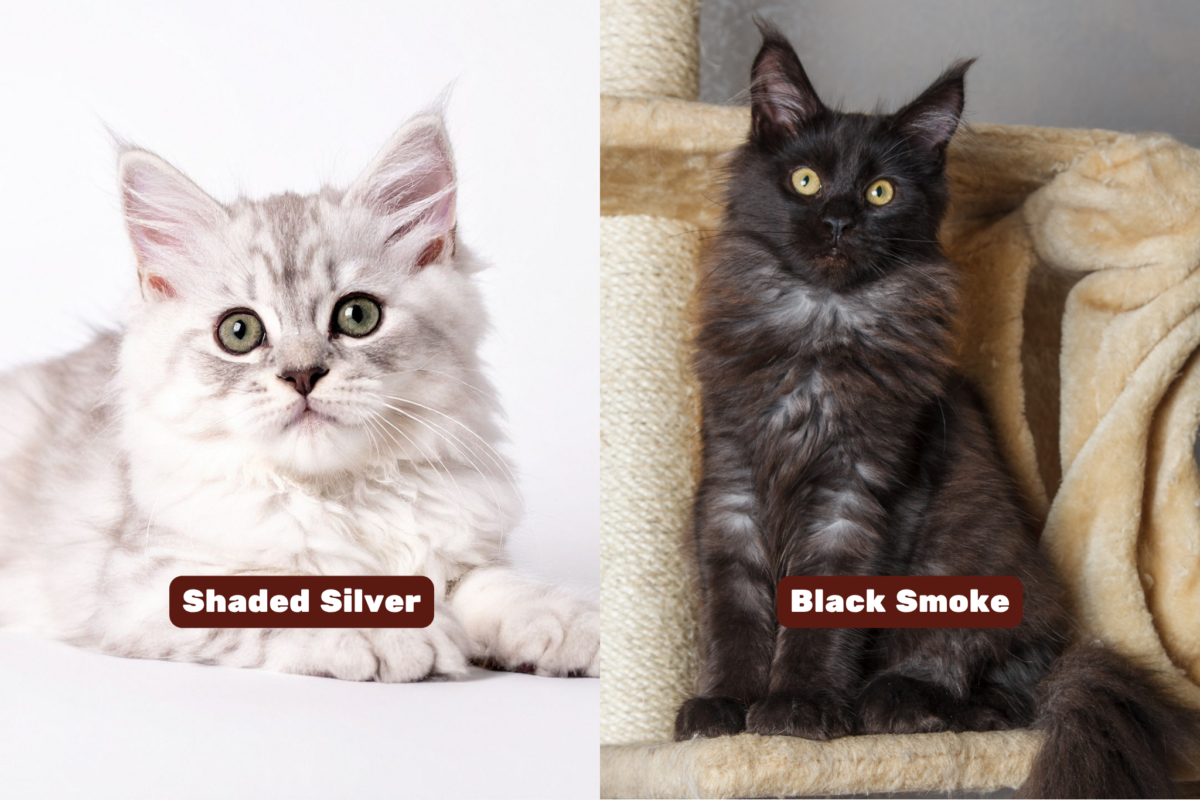
- Chinchilla: Only the very tip of each hair is pigmented (about 1/8). The coat appears extremely pale, almost white, with a soft, sparkling effect.
- Shaded: More of the hair is pigmented (about 1/4), creating a gentle gradient from dark to light. The overall look is darker and more dimensional than chinchilla.
- Smoke: Most of the hair is pigmented, with a pale base hidden underneath. The coat often appears solid at first glance, with contrast revealed when the fur shifts or is parted.
Watch: Not white — just barely tipped. Three chinchilla silver kittens showing how little pigment it takes.
Quick Takeaway
The difference comes down to where the pigment sits on the hair:.
- Chinchilla: pigment at the tip
- Shaded: pigment extends further down
- Smoke: pigment covers most of the hair, with only the base left light
Chinchilla vs Solid White
Both can appear nearly white, especially in bright light. But one has pigment. The other hides it completely.
The easiest place to look is the face. Chinchilla Maine Coons almost always have visible outlining around the eyes and nose, while solid white Maine Coons do not.
How To Tell At A Glance
- Dark eye, nose, or lip outlining → chinchilla
- Completely pink nose with no outlining → white
- Dark paw pads → chinchilla
- Pink paw pads → white
- Subtle shading or sparkle in the coat → chinchilla
- Flat, uniform white coat → white
White vs Albino
White Maine Coons are often mistaken for albino cats. But they are genetically and visually very different.
Albino cats lack pigment entirely due to a genetic mutation. They often have very light-sensitive eyes, reduced visual pigment, and a more washed-out appearance overall.
In contrast, white Maine Coons typically have normal vision, more defined facial features, and richer eye color (even when blue).
How To Tell At A Glance
- Blue, green, gold, or odd-colored eyes → white Maine Coon
- Pale pink or blue eyes → albino
- No visible pigment anywhere (coat, skin, eyes) → albino
- May have pink nose and paw pads → both
Silver vs Blue (Gray)
At a glance, both can look gray. But one is a flat color. The other has depth.
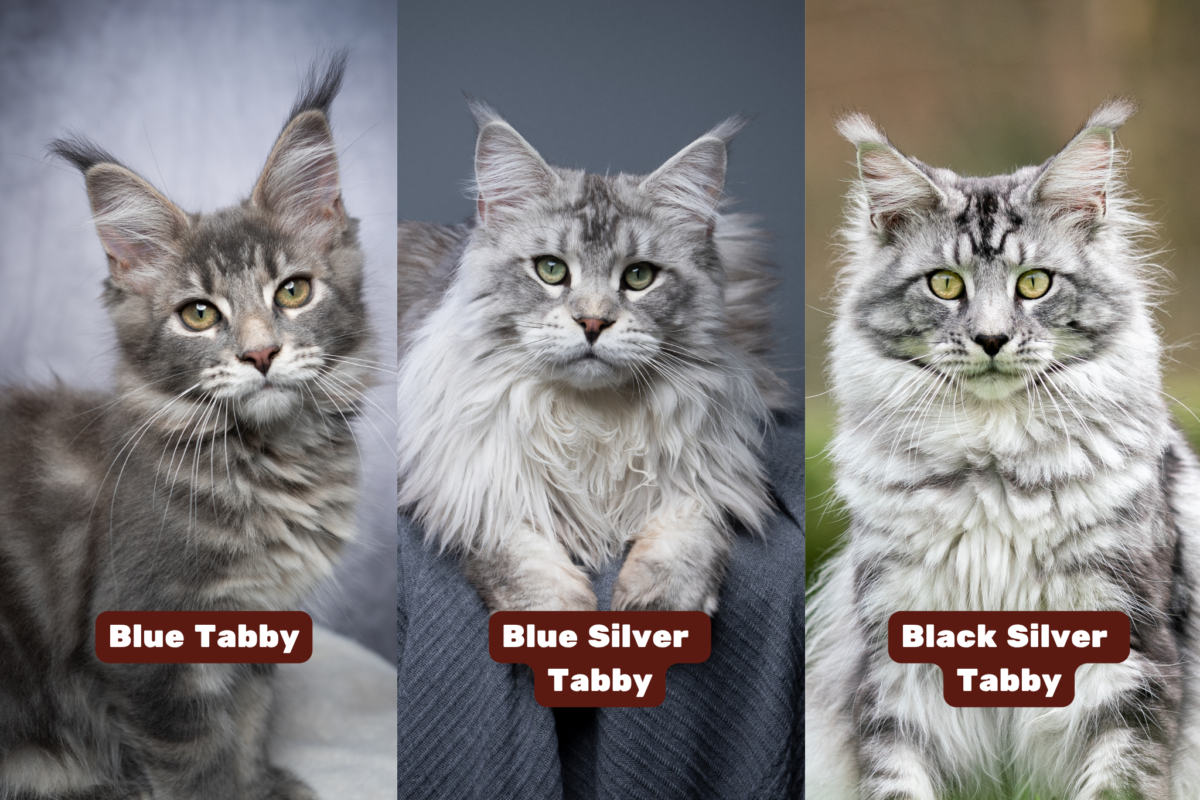
Silver is not a color on its own, but a genetic modifier. The inhibitor gene removes pigment at the base of each hair, creating a white undercoat with darker tipping or markings layered on top.
In everyday language, terms like “silver tabby” are often used as shorthand for multiple coat types within this group.
On the other hand, blue (gray) is a dilute version of black. The coat is one consistent gray tone from root to tip, with no white undercoat.
Quick Takeaway
- Silver = layered color (light + dark)
- Blue = solid color (one tone)
Solid Red vs Red Tabby
Most “orange” Maine Coons are actually red tabbies. True solid red Maine Coons exist, but visually, the line between the two can be surprisingly blurry.
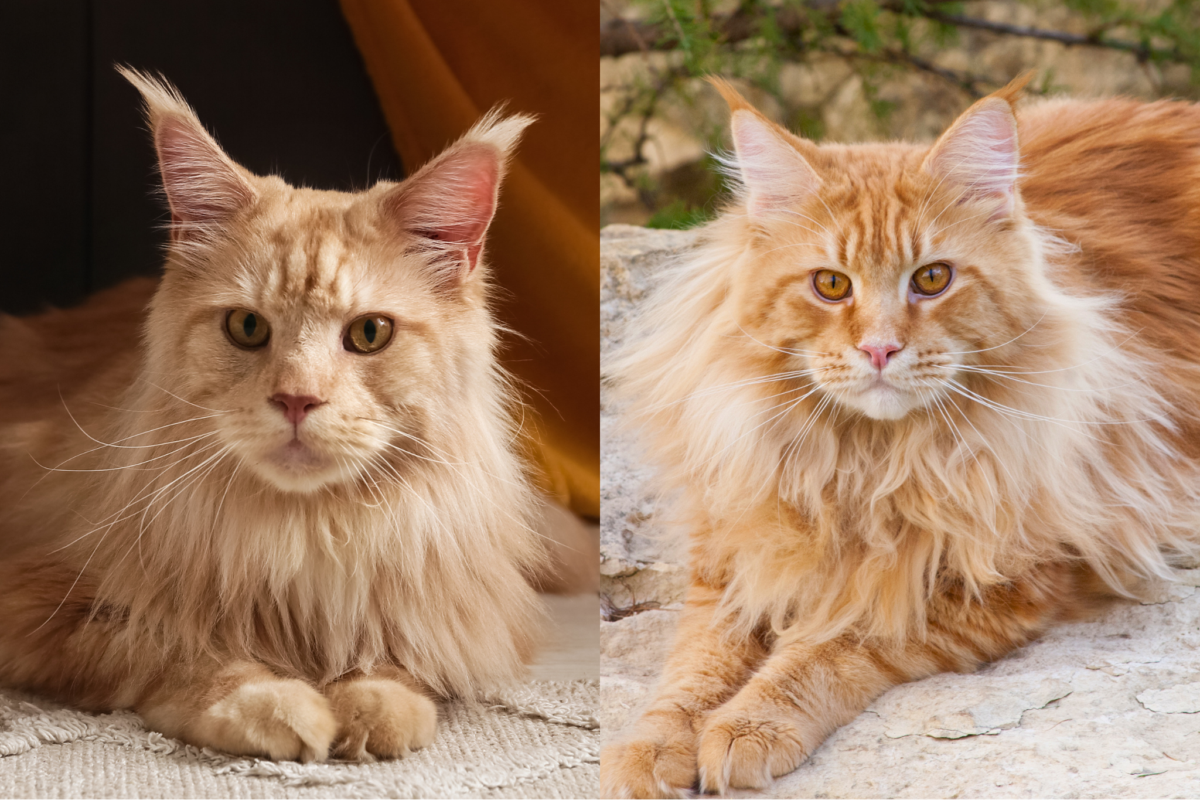
Red pigment doesn’t fully suppress pattern, so even cats that are genetically “solid” often show faint striping, known as ghost markings. That means both solid red and red tabby Maine Coons can appear striped at first glance.
The Easiest Way To Tell
Check the chin.
- Solid red: Chin is the same color as the rest of the coat
- Red tabby: Chin is often lighter or white
This is one of the quickest and most reliable visual checks.
Calico vs Tortoiseshell
These two are often grouped together because they all combine black and red (orange) coloration.
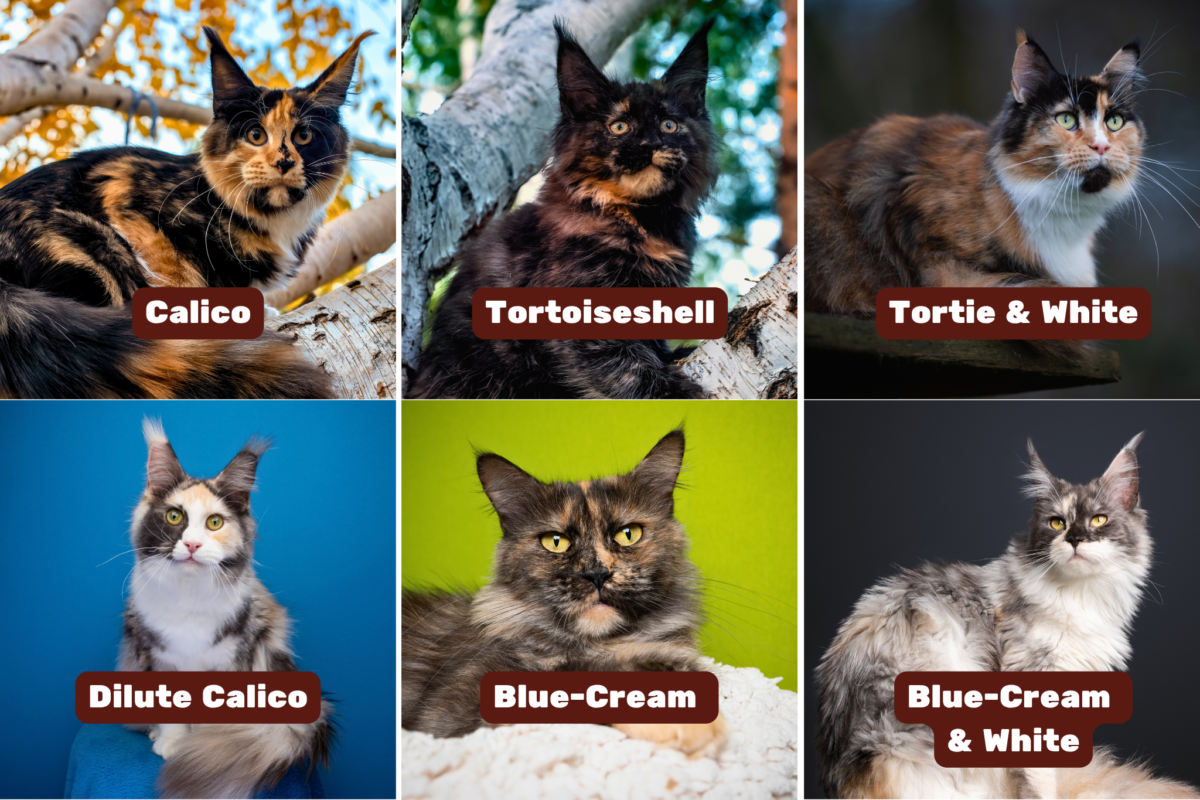
Start With This Rule
Look for white first.
- White present → calico
- No white → tortoiseshell or torbie
That one detail eliminates most confusion. From there, you can factor in dilution and pattern.
Parti-Colors & White
- Calico: Large, distinct patches of black, red, and white. Colors are clearly separated.
- Dilute Calico: Softer version of calico. Black appears gray (blue), and red appears cream.
- Tortoiseshell (Tortie): No white (or very little). Colors are blended or mottled together.
- Blue-Cream: Dilute version of tortoiseshell. Gray (blue) and cream are mixed together in a soft, marbled pattern.
- Tortoiseshell & white: Tortie with white on face (optional), bib, belly, and all four paws.
- Blue-cream & white: Diluted version of tortie and white.
Rare Doesn’t Mean Better (But It Does Change Price)
Rare colors get attention. Golden, chinchilla silver, and high-quality solid coats often come with higher price tags, sometimes significantly higher. But color alone does not determine quality.
Health, temperament, and responsible breeding matter far more than coat color ever will. A rare color from a poor breeder is still a poor outcome.
What Actually Drives Price
- Breeder reputation and lineage
- Health testing and guarantees
- Pedigree and show quality
- Demand for specific colors
Color can influence price, but it should never be the deciding factor.
Key Takeaway: Rare colors increase demand, not value.
Frequently Asked Questions
Most readers come in wondering about one color and leave realizing there’s more to it. Here are the questions that come up most often.
Don’t see your question? Respond in the comments, and we’ll get back to you!
What Is The Rarest Maine Coon Color?
Golden Maine Coons are widely considered one of the rarest due to their complex genetics and unpredictable breeding outcomes. Chinchilla silver and true solid coats are also uncommon.
What Is The Most Common Maine Coon Color?
The most common coat you’ll see on a Maine Coon is tabby. In fact, it’s more accurate to think of tabby as the default. It appears more frequently than any single color because it’s tied to the agouti gene, which is widely present and dominant in cats.
In practice, that may look like:
- Brown tabby (the most recognizable “classic” Maine Coon look)
- Silver tabby
- Red tabby (orange)
- Tabby patterns combined with white
It’s also worth noting that “tabby” refers to a pattern, not a single color. That’s why Maine Coons can look very different from one another while still technically being tabby.
Are White Maine Coons Albino?
No. White Maine Coons are not albino, and the difference comes down to genetics.
White Maine Coons carry a dominant white gene that masks their true underlying color. Genetically, the cat could be black, tabby, or even calico, but that color is hidden by the white coat.
Albino cats are completely different. They lack pigment entirely due to a genetic mutation that prevents melanin production. Albino cats often appear more washed out and typically have very pale blue or pinkish eyes.
Why Do Red Maine Coons Still Have Stripes?
Because red pigment does not fully suppress tabby patterning. Even genetically solid red cats will show faint “ghost” markings.
Are Calico Maine Coons Always Female?
Almost always. Calico coloring requires two X chromosomes, which is why it typically appears in females.
Male calicos are extremely rare.
Do Rare Maine Coon Colors Cost More?
Sometimes. Certain colors are in higher demand, but price is driven more by breeder quality and lineage than color alone.
What Color Maine Coon Is Most Expensive?
Golden and high-contrast silver (like chinchilla) often command higher prices, but this varies widely by breeder and region.
More Maine Coon Cat Colors
Want to see more Maine Coon colors? Explore our guides to the Blue Maine Coon, the Orange Maine Coon, or browse the full range in our complete Maine Coon colors guide.