When you purchase through links on our site, we may earn a commission at no extra cost to you. Learn more.
The winter holidays are here, and while you’re dreaming of eggnog and silent nights, your cat is plotting a festive coup. Why? Because for your feline friend, Christmas doesn’t just bring joy and tasty tuna; it brings them the ultimate, limited-edition, indoor climbing apparatus: The Christmas Tree.
Table of Contents
Think about it from their perspective: you’ve delivered a giant, scratchable, jungle gym right into the living room! It comes pre-loaded with dangling, shiny, noise-making toys (ornaments), beautiful ribbons (tinsel), and a cozy carpet cave (the tree skirt), perfect for surprise attacks. It is, unequivocally, the most magnificent tower of pure, unadulterated chaos they have seen all year.
For us, the proud (and slightly traumatized) cat parents, setting up that fir sometimes brings a sense of dread. The moment that glorious pine hits the stand, your cat transforms from a sleepy lap-dweller into an Olympic climber, ready to shred your holiday cheer into tiny, sparkly pieces.
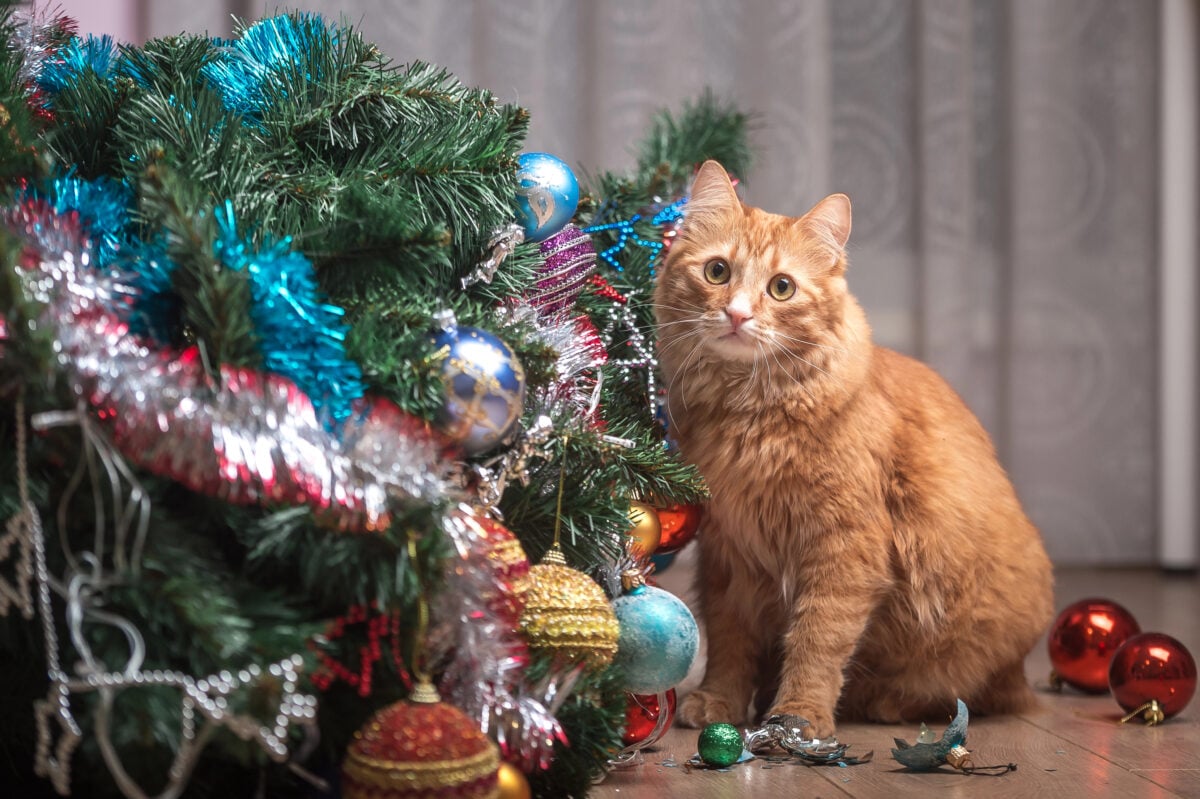
Whether it’s real pine or fake plastic, to a cat, a Christmas tree is an open invitation to an annual, high-stakes game of “The Floor is Lava… and the Ceiling is Ornaments.”
If you’re already stressed about the impending disaster, don’t worry. You don’t have to choose between a festive home and a full insurance deductible. We are here to help you keep your tree upright and your sanity intact this holiday season. Let the cat-proofing begin!
Live From the Living Room: Cats vs. Christmas Tree Mayhem
Get ready for holiday mayhem: in this video, festive fluffballs treat the Christmas tree like it’s a giant scratching post. Ornaments fly. Branches bend. Cats plot silent coups atop tinsel-laden boughs. And when the tree finally topples, you can almost hear them whisper, “Not me. Must’ve been the wind.”
The Battle for the Tree: Why Your Cat is Obsessed
So, before we dive into the defensive strategy, we need to understand the enemy’s motivation. Why does your sweet, unassuming fluffball suddenly transform into a tiny, green-destroying menace? It’s not personal, it’s instinct.
They aren’t trying to ruin your holiday; they are simply answering the call of the wild, which happens to be emanating from a freshly cut (or manufactured) pine.
The Problem: An Irresistible, Fuzzy-Brained Temptation
You see a beautifully decorated symbol of holiday tradition. Your cat sees a custom-made, adrenaline-pumping, multi-level playground. Why is this inanimate object so maddeningly irresistible to your feline overlord?
- The Ultimate Scratching Post (with Perks): Real or fake, the trunk is irresistible. Cats are masters of vertical ascent, and you’ve just installed a twenty-foot-tall scratching post with excellent grip. It’s a literal climbing gym!
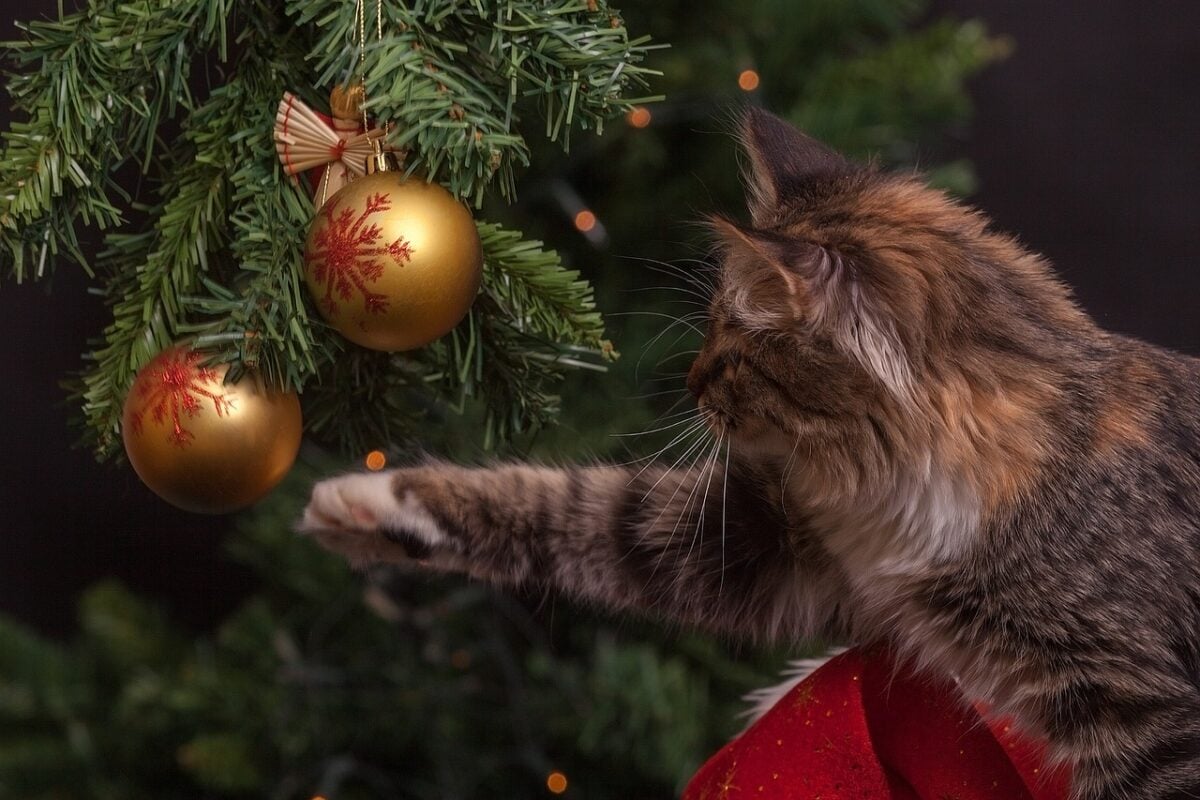
- The Dangly Disco Ball Effect: Those shiny ornaments? They are not peaceful decorations; they are swinging targets designed for batting practice! Every delicate glass ball is a challenge, every tinsel strand is a dangerous, shiny rope they simply must investigate (and possibly ingest).
- New Smells, New Territories: The fresh pine smell, the dusty box smell, the new plastic smell, it’s all a sensory feast. To a cat, the tree is a brand-new, unauthorized piece of furniture that needs to be rubbed, claimed, and thoroughly tested for structural integrity. Some cats even eat them, real or fake.
The Goal: Safety, Sanity, and No $500 Emergency Vet Bills
Your mission, should you choose to accept it, is not merely to save your vintage ornaments but to achieve a simple, peaceful holiday season. The stakes are high:
- Toppled Tree Tragedy: A full-grown cat launching itself off the top branch can turn your living room into a lumberjack’s yard sale faster than you can say “Meowy Christmas.” We aim to have zero seismic events this December.
- Ornament Catastrophe: Broken glass everywhere, resulting in sad, expensive clean-up and a possible paw injury. We want shatterproof success and happy feet.
- Tinsel Terror: That sparkly stuff is an intestinal nightmare! If swallowed, tinsel can cause serious (and seriously expensive) vet issues. Our goal is a tinsel-free triumph over ingested danger.
Ready to secure the fortress? Let’s move on to locking down that vertical menace!
Fa-La-La-La-Feral: Destruction in Real Time
Let’s pause for a moment of festive honesty. This is exactly what happens when cats meet Christmas trees. Enjoy.
Prevention Strategies: Building a Feline-Proof Fortress
Holiday peace begins with one mission: keep the tree upright. Here’s how to build defenses strong enough to withstand a whiskered wrecking ball.
1. Choose the Right Tree: Know Your Limits
Before you commit to that majestic tree, consider your cat’s athletic résumé. Are they climbers? Chewers? Champion-level parkour jumpers? Plan accordingly.
Smart Strategies
- Go artificial to avoid toxic sap, dirty tree water, and needle-filled vet bills.
- Downsize to a tabletop tree if your cat treats gravity like a suggestion, not a rule.
- Pick thicker branches that are harder to scale and swing from.
- Avoid real pine if possible; it offers a buffet of potential hazards for curious cats.
Honest truth: a fake tree usually means fewer 2 a.m. “Why is my cat foaming at the mouth?” searches.
2. Secure the Asset: Anchor Like an Admiral
Do not rely on the tree stand alone. It will disappoint you. Cats have already proven they are stronger than most tree stands. Tethering the tree to the wall or ceiling is a common practice among seasoned cat owners.
Smart Strategies
- Choose a broad, heavy base that can handle feline aerial assaults.
- Run an invisible fishing line or thin wire from the trunk to a wall hook, wall stud, or ceiling anchor.
- Avoid launch pads like sofas, shelves, and strategically placed cat towers.
- Double anchor if you live with a daredevil who thinks your living room is a stunt set.
Goal: make the tree as solid as your determination to enjoy the holidays.
3. Introduce the Tree Slowly (The Soft Launch)
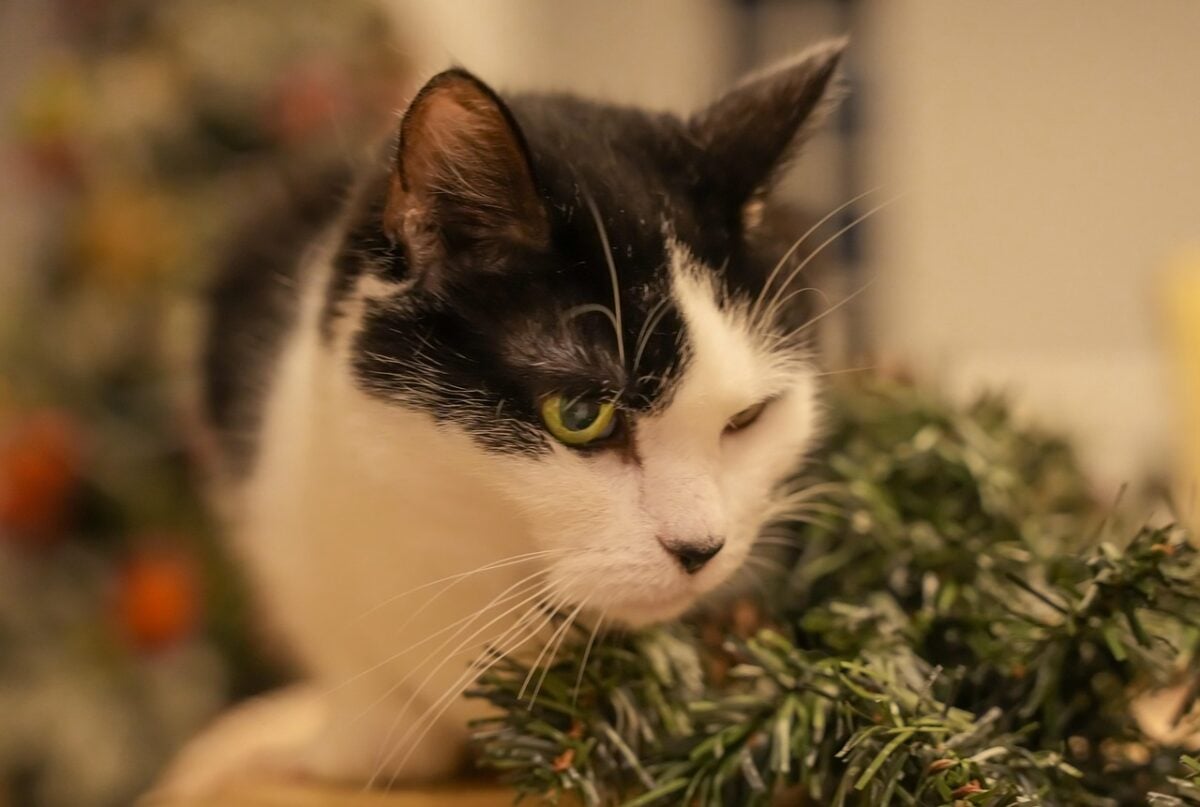
Let the novelty wear off before the shiny toy store arrives. Give your cat some time to get used to a new tree in the house, without any of those shiny distractions.
Smart Strategies
- Put up a bare tree first so your cat can sniff it, inspect it, and eventually get bored.
- Apply cat-safe deterrents to lower branches early to establish boundaries.
- Supervise first encounters so you can guide behavior and redirect when needed.
- Reward disinterest. Boredom is your greatest ally here.
Think of this as a “meet and greet” for a giant indoor stick.
4. Ornament Defense Tactics: Outsmarting the Glitter Gremlin
Ornaments are cat treasure. Your job is to protect the treasure without losing your mind.
Smart Strategies
- Keep fragile or sentimental ornaments high up, out of easy paw range.
- Use wood, felt, or shatterproof decorations on the lower branches.
- Secure ornaments tightly with ribbon loops or twist ties instead of flimsy hooks.
- Skip oversized dangling ornaments near the bottom. If it swings, a cat will claim it.
Decorate like a museum curator preparing for a feline art heist.
5. Lights, Cords, and Other Sparkly Threats
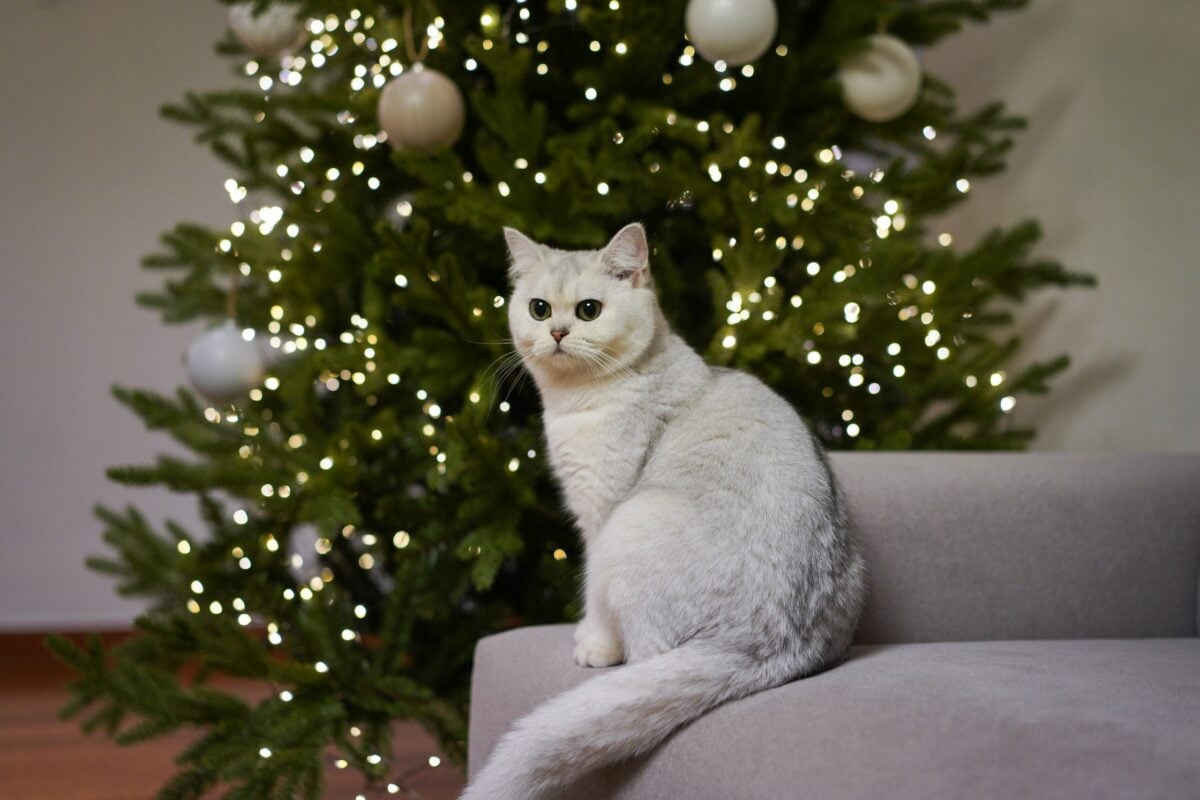
Electric cords are not snacks, no matter what your cat thinks. Secure your lights, hide loose cords, and replace fragile hooks with safer fasteners, as cats often treat dangling items as toys made just for them.
Smart Strategies
- Hide cords with covers or run them along the trunk where cats cannot easily reach them.
- Avoid flashing or strobe settings that look like prey in motion.
- Tape or clip wires so they do not dangle like exciting new toys.
- Unplug lights overnight or whenever you are not home. Cats love late-night experiments.
Enjoy the holiday lights, not a surprise call to your electrician.
6. Cat-Proofing the Surrounding Zone
The tree is not the only problem. The approach route is half the crime.
Smart Strategies
- Remove lift-off points near the tree to stop feline parkour missions.
- Add enrichment nearby, such as puzzle toys, scratchers, or catnip, to redirect energy.
- Create a special holiday cat zone, so they have their own spot to explore and enjoy.
- Use soft barriers, such as aluminum foil or prickly mats, around the base to signal “do not enter.”
- Create a transparent barrier with a decorative pet gate or holiday-themed screen to block direct access.
Make your tree the most boring structure in the room. Sorry, tree.
5 Immediate Strategies to Keep Your Cat Out of the Tree
Okay, the tree is up, it’s anchored like a battleship, and you’ve used shatterproof ornaments on the bottom branches. That’s excellent defensive groundwork! Now, we move into the active phase of the war because even a well-secured tree is still a temptation.
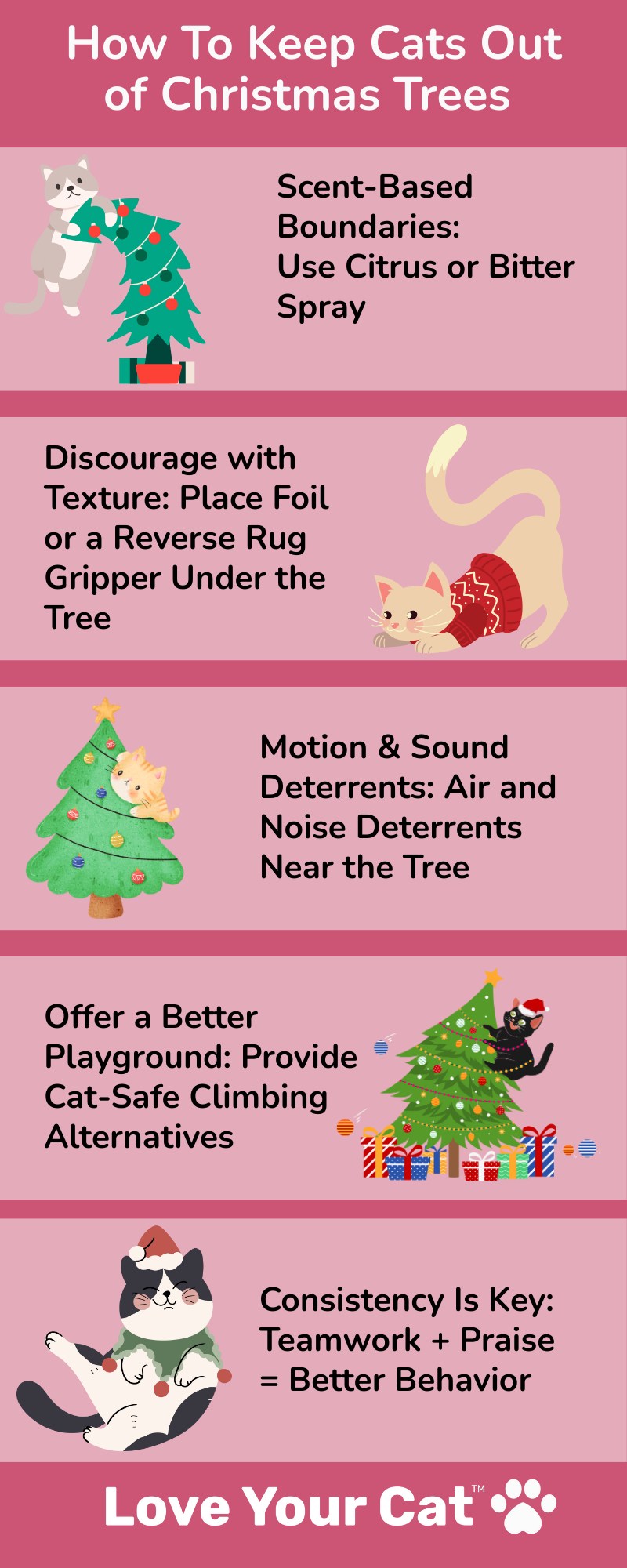
To lock down your living room and ensure holiday harmony, here are the five immediate strategies you need to deploy right now to stop your cat from turning your tree into a jungle gym.
1. Scent-Based Boundaries
Cats trust their noses more than their eyes. If the tree smells like a bowl of holiday punch gone wrong, most felines will abandon the mission. Place fresh or dried orange or lemon peels around the base, ensuring they are securely tucked under the tree skirt.
Note: Citrus peels are an effective deterrent, but cats should not eat them. The essential oils in citrus can irritate the stomach if swallowed. Place peels where the scent is strong but the fruit itself is not accessible.
You can also spray the lower branches with a cat-safe citrus or bitter no-chew spray. Over time, the smell alone signals that the tree is not worth the trouble.
Try This
- Citrus peels under the tree skirt
- Citrus spray or bitter spray on lower branches
This simple scent barrier can turn your tree into a strictly decorative feature instead of a scented jungle gym. With the scent doing the work, the tree becomes less appealing as a playground.
2. Discourage with Texture
Cats are brave until their paws touch something crunchy, unstable, or mildly offensive to their delicate toes. Aluminum foil makes an inconvenient landing pad, and a reversed rug gripper or scat mat adds a mildly uncomfortable texture that discourages paws from landing.
When the ground becomes unfamiliar and annoying, most cats decide that scaling the Christmas tree is not worth the discomfort.
Try This
- Aluminum foil beneath the tree skirt
- Reversed rug gripper or a basic scat mat
- Expand the textured zone if your cat keeps testing the boundaries
This creates an invisible “no-go” border that quietly protects your holiday decor.
3. Motion & Sound Deterrents
The element of surprise can be an effective way to discourage climbing. A motion-activated air puff can make it seem like the tree has its own gentle protective shield. Light sounds, such as a soft rattle or a nearby toy bell, can also interrupt the moment and redirect your cat’s attention toward something more appropriate.
Try This
- Motion-activated air deterrent, such as Ssscat, near the base of the tree
- Keep a soft rattle or jingle bell to gently interrupt and redirect
- Rotate deterrent placement so there is no predictable safe approach
Once your cat starts to believe the tree is not a friendly climbing structure, their curiosity usually shifts to more rewarding adventures.
4. Offer a Better Playground
Cats need vertical adventure in their lives. If you offer a more appealing climbing challenge, such as a tall cat tree or wall-mounted shelves full of fun distractions, they are more likely to choose it instead.

Daily playtime also releases the pent-up energy that often sends them flying into your ornaments at night.
Try This
- Add a new cat tree or vertical wall shelves so that they can truly claim them as their own
- Place engaging toys like feather wands and catnip mice near their furniture
- Schedule evening play sessions to burn off extra energy before bedtime
A cat who feels fulfilled and engaged will usually choose their own territory over your Christmas tree.
5. Consistency Is Key
Cats are master negotiators who look for the tiniest loopholes. If one family member allows just a little tree climbing, the entire training plan starts to crumble.
For any technique to work, consistency is critical. Every single person in the house must use the same deterrents (noise, spray, etc.) every single time the cat attempts a climb. Praise and treats for ignoring the tree go much further than scolding once they are already inside it.
Try This
- Use the same rules and responses from every family member
- Offer instant rewards when your cat chooses their own furniture instead of the tree
- Plan short supervised sessions when the decorations first go up
With consistent responses and plenty of rewards for good choices, your cat can learn that the holiday centerpiece is strictly off limits as a climbing gym.
Training Tips to Help Your Cat Respect the Tree
Teaching your cat that the tree is not a climbing challenge helps build long-term success. Training or discipline works best when it feels like a fun game with great rewards. Focus on redirection and positive reinforcement to encourage the choices you want to see.
How to Train Kindly and Effectively
- Reward your cat immediately when they walk past the tree without approaching
- Use interactive toys to shift attention away from the tree when curiosity spikes
- Try clicker training or a simple marker word like “yes” to reinforce good behavior
- Plan short supervised sessions to help your cat build the new habit
- Provide extra enrichment games and puzzles so the tree is not the most exciting thing in the room
The more your cat learns that ignoring the tree earns treats and praise, the faster you will see a calm and holiday-friendly routine take shape.
Does an Upside Down Christmas Tree Work?
An upside-down tree hangs from the ceiling or high on a wall, turning a classic holiday icon into a statement piece. It can limit access to lower branches, making the tree less climbable for some cats. However, it is not always the perfect cat-proof solution.
What It Helps With
- Reduces footholds and landing spots for climbers
- Keeps ornaments and branches out of easy reach
- Can deter cats who avoid larger jumps or wall climbing
What It Does Not Solve
- Determined jumpers may still try to reach it from furniture
- Ornaments still dangle and can attract paw swats
- Wall climbers may view it as a bigger challenge
An upside-down tree can reduce temptation and protect lower decorations, but it is most effective when combined with other cat-friendly prevention strategies.
What About Putting the Tree on a High Table?
Elevating the tree onto a sturdy table or cabinet is a common tactic to keep curious paws away. It can work for some cats, especially those who rarely jump or climb. However, many cats see extra height as an irresistible upgrade to their holiday playground.
When It Can Help
- Keeps the tree out of reach for cats that do not jump to high furniture
- Reduces access to lower branches and wires
- Makes it easier to block the area beneath the tree
Potential Problems
- Creates a new launch pad if the table is near shelves or sofas
- Falling from a table has a higher risk of damage or injury
- Some cats love the higher view and become even more determined to climb
Raising the tree can help in some homes, but success depends on your cat. For jump-loving climbers, a high table might simply turn the Christmas tree into the ultimate lookout tower.
Other Creative DIY Solutions to Protect Your Christmas Tree
If you have an especially determined climber, a few smart modifications can make a huge difference. These ideas help keep the tree upright, limit access, or rethink the holiday setup entirely while still keeping the festive magic alive.
Try These Clever Alternatives
- Upgrade to a weighted or extra-wide stand to prevent tipping during climbing. You can build your own out of scrap wood fairly easily.
- Wrap the lower trunk with sisal rope to provide texture that cats dislike, while protecting bark or branches.
- Decorate a felt or wooden wall-mounted tree as a complete tree replacement for homes with extreme climbers.
- Use shatter-resistant ornaments or soft fabric decorations to reduce risks of breakage and injury.
- Cover the tree water reservoir with a tight lid to prevent cats from drinking or splashing in it.
- Secure ornaments with ribbon or twist ties instead of loose hooks that are easy to swipe loose.
When it comes to cats and Christmas trees, perfection is not the goal. Survival is. A mix of thoughtful planning, gentle training, and a few creative DIY tweaks can turn full-scale ornament trouble into the occasional harmless paw tap.
Your tree stays standing, your cat stays safe, and you still get to enjoy that warm, twinkly holiday glow without holding your breath every time you hear a tiny jingle in the next room.
Enjoying the Holidays With Your Cat
Once your tree is secure and your prevention strategies are working, you can focus on what really matters during the holidays: enjoying time with your cat.
Treat them to something special by exploring safe seasonal snacks in our guide on what human food cats can eat, or make homemade meals and goodies from our cat food recipes and cat treat recipes. And because the best part of the season is the love you share, take a moment to learn the signs your cat has imprinted on you so you can appreciate just how much joy and comfort they bring to your home. With a bit of planning and a lot of love, you can enjoy a holiday that feels magical, safe, and wonderfully cat-friendly.
Calling All Cat Parents: How Do You Save Your Christmas Tree?
Every cat is unique, and every home has its own holiday strategy. Have you found a clever way to keep your cat out of the Christmas tree? Tell us what has worked for you in the comments below so other cat parents can enjoy a safer and more peaceful holiday season, too.